It's my second last day of teaching. The month of January is drawing to an end. And my departure from Buenos Aires is drawing closer and closer. I don't exactly have a date of departure or an itinerary yet; I have to get to Santiago for my flight on March 1st, and I'm going to get there overland. I want to see the south of Argentina, I want to see Misiones province in the extreme north. I want to see the mountains, I want to see the ocean. I have to connect the dots and esee what I want to see and also get myself to the other side of the continent in time for my flight back to snowy Canada.
It hit me last week as I looked at the calendar how little time I have left here in this city. Even though I've just been here for a couple of months, you start to put down roots in your own little ways. You start to make long term plans and projects. But I realized last week that all those things I've been meaning to see and do in this city but keep putting off? If I don't get around to them now, they won't get done. The next week will be busy.
It's sort of sad, you know? The friends I'll be leaving, the students of mine that were practically crying when I told them I had to go... But at the same time there's the undeniable impression that life goes on and it will go for everyone once you leave. Departures always seem to provoke these two opposing feelings....
Tuesday, January 30, 2007

Wednesday, January 24, 2007
Love and marriage
The economic crisis of 2001 has impacted Argentine society in innumerable ways. Someone explained the ever declining national rate of marriage saying that it's because people just don't have the money since the crisis. If they're going to have a wedding, they want to do it right, so if they can't, they just don't bother. They'd just as rather live in sin.
I'm not sure how much I believe this one. Maybe societal views toward marriage have been changing as they have in countries all over the world. But there's an omonious Catholic cloud, remnants of things past, that floats over this country and unfortunately still casts its shadow over everything from public opinion to law-making. So maybe if you can justify your living in sin economically, it's harder for people to label your evolving social values as immoral.
I'm not sure how much I believe this one. Maybe societal views toward marriage have been changing as they have in countries all over the world. But there's an omonious Catholic cloud, remnants of things past, that floats over this country and unfortunately still casts its shadow over everything from public opinion to law-making. So maybe if you can justify your living in sin economically, it's harder for people to label your evolving social values as immoral.
Tuesday, January 23, 2007
Lingua Franca
It's now pretty much established that English is the global lingua franca, especially in the realms of technology and business. That there's a common language to facilitate intercultural communication between groups isn't undesirable - having a language in common makes international gatherings a lot easier. But what's unique about the current situation is that English isn't some neutral third party language used for communications purposes only, there are millions of native speakers of the language who have a definite advantage when it comes to the manipulation and use of this lingua franca. This is in contrast to something like Latin, which was the lingua franca of the Catholic church, but which no one spoke natively.
English speakers are spoiled - the global lingua franca is their native language. They can reap all the benefits of the use of this global language, without having had to go through the long, slow process of learning a foreign language. As a result, there is an important number of English speakers who don't speak any foreign languages beyond Tarzan-talk - practically speaking, they don't really have to, so why bother? When an monolingual English speakers sets out on a trip, to assuage their fears of communicating in a foreign country, they can say to themself, " There's always someone around who speaks some English..."
And they're usually right. In major cities and tourist centres there IS usually someone who speaks some English. So you can get by.
But your bus driver, bar tender, the random person you ask for directions on the street, the grandma waiting for the bus with you on the street corner, the lady that sells you fruit in the market, the corrupt police officer waiting for a bribe; these people probably don't speak English. Yeah, you CAN get by with hand gestures or drawings, but isn't it more fulfilling, not to mention more informative, to be able to carry on a conversation? Maybe your tour guide can speak some English, but isn't it better to get the witty and comprehensive 15 minute explanation of the monument you're looking at in the local language as opposed to the abbreviated, stiff, badly pronounced 5 minute English version? Isn't better to be able to haggle over the price of the handcrafts you're buying instead of just having to accept whatever price they tell you? Isn't it better to have some idea whether someone yelling at you on the street is telling you how beautiful you are or that they're going to rob you? I think it is.
I didn't always feel this way, though. In the past when I travelled in places where I didn't know the language, I took the daily doses of extreme frustration at not being able to communicate as part of the travelling experience. Didn't realize there was an alternative to the linguistic barrier between me and the locals that kept my interaction with anyone other than tourism professional quite superficial. But then I went travelling in places where I knew the language, and the experience was like night and day. And now I'm a convert. You don't have to have Shakespearean prowess in the local language. Just enough of the basic structures and vocabulary to actually carry on something that resembles a real conversation.
I think "There's always someone who speaks English," should be banned from everyone's travel vocab.
English speakers are spoiled - the global lingua franca is their native language. They can reap all the benefits of the use of this global language, without having had to go through the long, slow process of learning a foreign language. As a result, there is an important number of English speakers who don't speak any foreign languages beyond Tarzan-talk - practically speaking, they don't really have to, so why bother? When an monolingual English speakers sets out on a trip, to assuage their fears of communicating in a foreign country, they can say to themself, " There's always someone around who speaks some English..."
And they're usually right. In major cities and tourist centres there IS usually someone who speaks some English. So you can get by.
But your bus driver, bar tender, the random person you ask for directions on the street, the grandma waiting for the bus with you on the street corner, the lady that sells you fruit in the market, the corrupt police officer waiting for a bribe; these people probably don't speak English. Yeah, you CAN get by with hand gestures or drawings, but isn't it more fulfilling, not to mention more informative, to be able to carry on a conversation? Maybe your tour guide can speak some English, but isn't it better to get the witty and comprehensive 15 minute explanation of the monument you're looking at in the local language as opposed to the abbreviated, stiff, badly pronounced 5 minute English version? Isn't better to be able to haggle over the price of the handcrafts you're buying instead of just having to accept whatever price they tell you? Isn't it better to have some idea whether someone yelling at you on the street is telling you how beautiful you are or that they're going to rob you? I think it is.
I didn't always feel this way, though. In the past when I travelled in places where I didn't know the language, I took the daily doses of extreme frustration at not being able to communicate as part of the travelling experience. Didn't realize there was an alternative to the linguistic barrier between me and the locals that kept my interaction with anyone other than tourism professional quite superficial. But then I went travelling in places where I knew the language, and the experience was like night and day. And now I'm a convert. You don't have to have Shakespearean prowess in the local language. Just enough of the basic structures and vocabulary to actually carry on something that resembles a real conversation.
I think "There's always someone who speaks English," should be banned from everyone's travel vocab.
Friday, January 19, 2007
Lust for Life
The residents of Buenos Aires, porteños, are major night owls. Dinner out at at 11pm, discos empty until 2am and rocking until 8am, overnight movie screenings at every theatre, cafés and ice cream shoppes bustling and the streets and busses packed well into the wee hours. There's a woman that sells newspapers all night on a busy street corner near my house and business is good. And this behaviour isn't just limited to young people or the over-the-hill party animal; the nighttime streets ofBuenos Aires are filled with porteños of all ages and social classes.
And this is not a weekends-only thing. Things are buzzing in this city any night of the week, with activity only getting more intense come Friday and Saturday nights.
But as much as porteños love their nightlife, the early morning demands of the modern workplace are the same as in any other city. So you may stay up until 2am on Tuesday night drinking espresso and talking politics with your pals in the café on the corner, but you still have to make it to work for 9am the next morning.
Does this stop porteños from enjoying food, wine, music and films, coffee and the company of each other, any night of the week? Not one bit. They'd rather not sleep than stop enjoying the finer things in life.
And if you ask anyone, they'll justify their sleepless existence in exactly this way. Yesterday in line at the drug store, Granny asks the cashier who can barely keep his eyes open if he'd had a late night the night before. As he yawningly answers yes, she comments that indeed, life is for living and basically encourages him to keep on givin' er.
It's your doctors, lawyers, accountants, bus drivers and store clerks that are sitting next to you on a Wednesday as you finish that last bottle of wine at dawn. They get up the next day on a few hours' sleep and perform surgery on you, oversee your personal affairs, serve your food and take down your credit card information.
Scary? I don't think so. Everyone seems to function just fine. You see, as opposed to someone who rountinely stays up late working, studying or performing some other disagreeable task, porteños are taking part in the the things they love. They love the night, they love discussion, conversing and debating with each other. And I think that's what gives them the energy and the motivation to live the routine parts of their professional lives. They've figured out what's important in life, and as opposed to letting the demanding realities of paying the bills distract them from the finer things, they've realized that it's these very things that make life worth living. And this allows, like, all of Buenos Aires to function on 5 hours sleep very night.
And there's this city's delicious espresso...
And this is not a weekends-only thing. Things are buzzing in this city any night of the week, with activity only getting more intense come Friday and Saturday nights.
But as much as porteños love their nightlife, the early morning demands of the modern workplace are the same as in any other city. So you may stay up until 2am on Tuesday night drinking espresso and talking politics with your pals in the café on the corner, but you still have to make it to work for 9am the next morning.
Does this stop porteños from enjoying food, wine, music and films, coffee and the company of each other, any night of the week? Not one bit. They'd rather not sleep than stop enjoying the finer things in life.
And if you ask anyone, they'll justify their sleepless existence in exactly this way. Yesterday in line at the drug store, Granny asks the cashier who can barely keep his eyes open if he'd had a late night the night before. As he yawningly answers yes, she comments that indeed, life is for living and basically encourages him to keep on givin' er.
It's your doctors, lawyers, accountants, bus drivers and store clerks that are sitting next to you on a Wednesday as you finish that last bottle of wine at dawn. They get up the next day on a few hours' sleep and perform surgery on you, oversee your personal affairs, serve your food and take down your credit card information.
Scary? I don't think so. Everyone seems to function just fine. You see, as opposed to someone who rountinely stays up late working, studying or performing some other disagreeable task, porteños are taking part in the the things they love. They love the night, they love discussion, conversing and debating with each other. And I think that's what gives them the energy and the motivation to live the routine parts of their professional lives. They've figured out what's important in life, and as opposed to letting the demanding realities of paying the bills distract them from the finer things, they've realized that it's these very things that make life worth living. And this allows, like, all of Buenos Aires to function on 5 hours sleep very night.
And there's this city's delicious espresso...
Sunday, January 14, 2007
El Cromañón
On December 31, 2004, there was a fire in the Cromañón nightclub in Buenos Aires. Not just any fire, though; 200 people died. And the repercussions can still be felt in the city to this day.
The rock band Los Callerjeros had been advertising a huge New Year's eve party, complete with firecrackers at midnight, in the República del Cromañón nightclub in the Once district that they had rented for the show. Except you weren't allowed to set off firecrackers inside the Cromañón; The Callejeros had apparently had had problems for setting them off there before.
So the show starts, and in addition to the firecrackers being shot off the stage, the audience starts shooting off the firecrackers they'd been urged to bring. At some point the band tells everyone to stop, but to no avail. The flammable sound-absorbing panelling that covered the ceiling caught fire, and starts to smoulder, producing huge amounts of highly toxic, chemical-saturated smoke. The electricity shorts and the lights go out.
And the emergency exits had been chained shut to prevent people from sneaking into the show.
So something 194 people died. Many of those who made it out of the bar died later in the hospital as the super toxic smoke pooled in their lungs and continued to burn them to death from the inside.
Now depending on who you ask, the blame for the tragedy rests on a few different people. The band and the producer of the show, who encouraged firecracker use, and who, as renters of the club, were technically responsable for what went on there. The club owners, who didn't enforce their own safety rules. And the municipal inspectors who are supposed to investigate and denounce infractions of municipal safety by-laws, but who rountinely and systematically accept bribes in exchange for turning a blind eye to any irregularities.
What's happened in the aftermath of the accident is that the city of Buenos Aires has introduced all these really strict by-laws regarding bars, clubs and live concerts. The best of intentions, but it's totally changed the nightlife scene here, according to some friends. In order to present any kind of live music, a bar needs all kinds of permits and permission. This is fine for bigger concert halls, but in the case of smaller bars that want to put on a little live entertainement, it's almost to the point where musicians have to pay to play. So many places just don't bother anymore. And I guess the city used to be overrun with fun, varied, interesting places to go out dancing. but now it's just the huge discotheques that can get the permits, so choices are limited, and quite mainstream.
And really, the problem in the first place wasn't really that there weren't strict enouigh by-laws. It was that they weren't being enforced. And though supposedly they've started to crack down on corruption among municipal inspectors, unless they can eliminate it completely, the strictest by-laws will be useless to prevent another Cromañón.
The rock band Los Callerjeros had been advertising a huge New Year's eve party, complete with firecrackers at midnight, in the República del Cromañón nightclub in the Once district that they had rented for the show. Except you weren't allowed to set off firecrackers inside the Cromañón; The Callejeros had apparently had had problems for setting them off there before.
So the show starts, and in addition to the firecrackers being shot off the stage, the audience starts shooting off the firecrackers they'd been urged to bring. At some point the band tells everyone to stop, but to no avail. The flammable sound-absorbing panelling that covered the ceiling caught fire, and starts to smoulder, producing huge amounts of highly toxic, chemical-saturated smoke. The electricity shorts and the lights go out.
And the emergency exits had been chained shut to prevent people from sneaking into the show.
So something 194 people died. Many of those who made it out of the bar died later in the hospital as the super toxic smoke pooled in their lungs and continued to burn them to death from the inside.
Now depending on who you ask, the blame for the tragedy rests on a few different people. The band and the producer of the show, who encouraged firecracker use, and who, as renters of the club, were technically responsable for what went on there. The club owners, who didn't enforce their own safety rules. And the municipal inspectors who are supposed to investigate and denounce infractions of municipal safety by-laws, but who rountinely and systematically accept bribes in exchange for turning a blind eye to any irregularities.
What's happened in the aftermath of the accident is that the city of Buenos Aires has introduced all these really strict by-laws regarding bars, clubs and live concerts. The best of intentions, but it's totally changed the nightlife scene here, according to some friends. In order to present any kind of live music, a bar needs all kinds of permits and permission. This is fine for bigger concert halls, but in the case of smaller bars that want to put on a little live entertainement, it's almost to the point where musicians have to pay to play. So many places just don't bother anymore. And I guess the city used to be overrun with fun, varied, interesting places to go out dancing. but now it's just the huge discotheques that can get the permits, so choices are limited, and quite mainstream.
And really, the problem in the first place wasn't really that there weren't strict enouigh by-laws. It was that they weren't being enforced. And though supposedly they've started to crack down on corruption among municipal inspectors, unless they can eliminate it completely, the strictest by-laws will be useless to prevent another Cromañón.
Thursday, January 11, 2007
Mate Ban
One of my Argentine friends told me her boss put a ban on mate drinking in the workplace. You can still drink tea or coffee, but he doesn't like his employees drinking mate in the office.
When my friend was telling me about this, I didn't quite understand what would be the motive behind such a ban, and was questioning her about it. Did he not like the messiness that comes with having your mate gourd, thermos of hot water and container of the loose yerba on your desk? Is it a foreign boss that finds the mate habit low- class and colonial?
"No, it's because he didn't like everyone talking and passing the mate around from person to person," she told me.
"Ah ha, so it's the social aspect of mate consumption that bothers him, " I answered. " Does that mean that if you huddled in your cubicle and drank your mate alone, like you drink coffee, it wouldn't bother him?"
"I suppose," she answered, "but that's not what mate's about."
This reminded me of an article I read recently in one of my Business English textbooks. A company, in an effort to increase productivity and reduce employee slacking off, redesigned their office space, but didn't include a common area or lunchroom, thinking that if the workers ate at their desks, they'd be more productive. Of course, this idea backfired; productivity went down and morale plummeted. It turns out that the lunchroom had been a place where people would casually bring up work problems they were facing, and colleagues would informally come up with solutions and brainstorm new ideas together. Not to mention let out a little of the desire for human contact and socializing that naturally accumulates after staring at a screen all day.
In a similar way, I think my friend's boss' ban on mate in the office is bound to do more harm than good. Yeah, the office will be quieter, but there's something to be said for workplace atmosphere. Maybe passing the mate gourd around the office every once in a while puts people in a good mood, helps them to get to know their colleagues, makes them enjoy being at work a little bit more. And that can only increase productivity, no?
When will bosses and directors realize that trying to make people behave like robots for the sake of productivity usually ends up backfiring?
When my friend was telling me about this, I didn't quite understand what would be the motive behind such a ban, and was questioning her about it. Did he not like the messiness that comes with having your mate gourd, thermos of hot water and container of the loose yerba on your desk? Is it a foreign boss that finds the mate habit low- class and colonial?
"No, it's because he didn't like everyone talking and passing the mate around from person to person," she told me.
"Ah ha, so it's the social aspect of mate consumption that bothers him, " I answered. " Does that mean that if you huddled in your cubicle and drank your mate alone, like you drink coffee, it wouldn't bother him?"
"I suppose," she answered, "but that's not what mate's about."
This reminded me of an article I read recently in one of my Business English textbooks. A company, in an effort to increase productivity and reduce employee slacking off, redesigned their office space, but didn't include a common area or lunchroom, thinking that if the workers ate at their desks, they'd be more productive. Of course, this idea backfired; productivity went down and morale plummeted. It turns out that the lunchroom had been a place where people would casually bring up work problems they were facing, and colleagues would informally come up with solutions and brainstorm new ideas together. Not to mention let out a little of the desire for human contact and socializing that naturally accumulates after staring at a screen all day.
In a similar way, I think my friend's boss' ban on mate in the office is bound to do more harm than good. Yeah, the office will be quieter, but there's something to be said for workplace atmosphere. Maybe passing the mate gourd around the office every once in a while puts people in a good mood, helps them to get to know their colleagues, makes them enjoy being at work a little bit more. And that can only increase productivity, no?
When will bosses and directors realize that trying to make people behave like robots for the sake of productivity usually ends up backfiring?
Home not so far
During my Chilean friend Claudia's first sub-zero winter in Montreal, her Canadian friends took it upon ourselves to mentor her in the art of surviving winter. There are little bits of knowledge you take for granted, having always grown up with snow and ice - how to dress in layers, what makes or breaks a good winter boot, what the difference between -10C and -25C really feels like.
One of the most important skills passed on was the art of walking on an icy sidewalk. I'd never really thought about it, but when it's icy you can't step down with all your weight on the ball or heel of your foot because it'll slide out from under you. So you walk in this flat-footed shuffle-y style, spreading out the point of contact between your foot and the slippery surface and therefore reducing the risk of falling.
Did you know that to walk on Buenos Aires' slippery tiled sidewalks in flip-flops when it's pouring rain you have to employ the exactly same technique?
One of the most important skills passed on was the art of walking on an icy sidewalk. I'd never really thought about it, but when it's icy you can't step down with all your weight on the ball or heel of your foot because it'll slide out from under you. So you walk in this flat-footed shuffle-y style, spreading out the point of contact between your foot and the slippery surface and therefore reducing the risk of falling.
Did you know that to walk on Buenos Aires' slippery tiled sidewalks in flip-flops when it's pouring rain you have to employ the exactly same technique?
Sunday, January 07, 2007
Reserva Ecologica

So, at some point, the city of Buenos Aires invested all this money into a nice riverfront promenade, the Costanera Sur. Tile sidewalks, lamposts, railings. Then they built a sort of man-made peninsula jutting out into the river that completley blocks the river from the promenade, meaning when you go for a stroll on the promenade you look out onto a really smelly swamp.
The good thing is that they turned the peninsula into an ecological reserve. There's plants, birds, animals, a couple of trails and some alright shoreline, and it's a stone's throw away from downtown.
The perfect sunday afternoon activity, we decided to check it out today, as the temperature actually dipped below 30C. There were a ton of people, lots of families and picknickers, but it was stil nice to get a little closer to something resembling nature. The poor kids on the beach all wanting to swim in the definitely UN-swimmable water, but being chastisted by the rent-a-cop/forest ranger if they went in anything deeper than their knees.
The Reserva is located sort of between downtown and the neighbourhood of La Boca, a working class section fo the city. So most of the people hanging around in the reserve and on the Costanera outside seem to be from the Boca, and so things have a different feel than a Sunday afternoon in well-to-do Recoleta. Also, families with money can go to the beach for the weekend, whereas for many in the Boca, the reserva's probably the closest thing to a beach as they can get.
The best part of going to the reserve is walking along the Costanera to get there. It's packed with families out for a stroll, and barbeque and ice cream stands, people selling stuff and parked cars with their stereos blasting cumbia. There's a big plaza right before you get to the entrance to the park, and there's this guy who does this sort of pseudo-karaoke show with music encompassing all things Argentine. Tango, folk music, cuartetto, cumbia, rock nacional, chamame, he has it all. Sometimes he sings the songs, and sometimes he just acts as DJ.
In the afternoon when we went into the park, the Karaoke guy was going strong, with lots of people sitting around listening and dancing. It's cool when he plays folk music, because there's always someone in the crowd from the Northern part of the country who knows the accompanying folk dances and just gets up and danced for the crowd.
We came out of the park and went for a long leisurely dinner at a parrilla grill nearby, and when we passed by on our way home, things had turned into an open-air family dance party. The plaza was a dance floor, lots of people had a beer in hand, and couples were dancing to the cumbia and salsa the Karaoke guy was putting on. I would imagine things go at least until midnight.
The art of the Sunday afteroon at it's best. I always though Montrealers were expectionally talented at the art of the Sunday afternoon. You go by any park in Mtl on a Sunday and it's full of people just hanging out. Maybe they're reading, playing with their kids, drinking beer with friends, playing frisbee, walking the dog. Maybe they're going for brunch, or a sangria on a terrasse or an ice cream. Whereas Saturdays are about taking care of the details you don't have time for during the workweek, it seems like Sunday's really just about relaxing, enjoying the outdoors, and being with your friends or family.
Here, as well, they've got this art down to a T. And they take it one step farther, with seriously the whole city participating ( as opposed to Montreal where there there's still a good portion of the population hidden away at home on a Sunday afteroon), and with the maxing and relaxing going well into the evening. It's really about enjoying all that's enjoyable and wonderful and easy in life.
January in Bs As
Everyone has been warning us for months about Buenos Aires in the summertime.
Supposedly, there's a mass exodus out of Buenos Aires in January toward the Atlantic coast and the beaches of Mar del Plata, or the coast of the Rio de la Plata north of the city. Unlike in Montreal where summer is the sweet reward for having survived the long cold winter, here it never gets THAT cold, so the summers are just hot. Really hot. And humid.
"It's SO dead in Bs As in the summer!" "It's so boring there's no one around and nothing happening!" "It's so hot, if you don't have air conditioning, you're going to suffer!" "The city's overrun with foreign tourists!" "You simply HAVE to leave the city in the summer!"
The warnings started as soon as I arrived. And now that the holidays are over and summer's really started, we're getting to see how much there is in all these ominous predictions.
But, I mean, not every single person in the city can pick up and go to the beach for a full month, can they? Some can't afford it, some are obliged to stay because of their jobs, and some just don't like laying on the beach with 200,000 other people and so will take their vacation later. And so those of us that are still around will do our best, I guess, to entertain ourselves.
A friend told me that the nightlife's really great in January because it's so hot no one emerges from their air conditioned caves until nightfall, when they let out all the day's energy on the dancefloor. Another friend told me that the city is void of kids in the summer so you can walk around in peace.
And so what's it REALLY like in Bs As in the summer?
Well, it was 43C on Monday. And almost that high for several days previous and since. Like, I had no concept of what 43 degrees was really like. 43 degrees in the middle of a huge, sprawling city, where garbage doesn't get collected the way it really should and where there's a complete lack of public swimming pools. 43C on New Year's day when all the malls, supermarkets and cinemas, those bastions of over-airconditioning, are all closed. But the last couple of days it's actually gone below 20C. And whenever the slightest complaint starts to form on my lips regarding the heat, I say to myself, " I could be in a sub-zero blizzard waiting for the 80 on Parc Ave. "
And there are fewer people on the streets. There are fewer big events advertised in the papers and on telephone polls. Some stores are closed up for a couple of weeks. And there are notiaceably more North American tourists escaping the northern winter. The city has slightly less of that buzzy, frenetic energy so omnipresent the rest of the year.
But it's by no means lost it all.
Supposedly, there's a mass exodus out of Buenos Aires in January toward the Atlantic coast and the beaches of Mar del Plata, or the coast of the Rio de la Plata north of the city. Unlike in Montreal where summer is the sweet reward for having survived the long cold winter, here it never gets THAT cold, so the summers are just hot. Really hot. And humid.
"It's SO dead in Bs As in the summer!" "It's so boring there's no one around and nothing happening!" "It's so hot, if you don't have air conditioning, you're going to suffer!" "The city's overrun with foreign tourists!" "You simply HAVE to leave the city in the summer!"
The warnings started as soon as I arrived. And now that the holidays are over and summer's really started, we're getting to see how much there is in all these ominous predictions.
But, I mean, not every single person in the city can pick up and go to the beach for a full month, can they? Some can't afford it, some are obliged to stay because of their jobs, and some just don't like laying on the beach with 200,000 other people and so will take their vacation later. And so those of us that are still around will do our best, I guess, to entertain ourselves.
A friend told me that the nightlife's really great in January because it's so hot no one emerges from their air conditioned caves until nightfall, when they let out all the day's energy on the dancefloor. Another friend told me that the city is void of kids in the summer so you can walk around in peace.
And so what's it REALLY like in Bs As in the summer?
Well, it was 43C on Monday. And almost that high for several days previous and since. Like, I had no concept of what 43 degrees was really like. 43 degrees in the middle of a huge, sprawling city, where garbage doesn't get collected the way it really should and where there's a complete lack of public swimming pools. 43C on New Year's day when all the malls, supermarkets and cinemas, those bastions of over-airconditioning, are all closed. But the last couple of days it's actually gone below 20C. And whenever the slightest complaint starts to form on my lips regarding the heat, I say to myself, " I could be in a sub-zero blizzard waiting for the 80 on Parc Ave. "
And there are fewer people on the streets. There are fewer big events advertised in the papers and on telephone polls. Some stores are closed up for a couple of weeks. And there are notiaceably more North American tourists escaping the northern winter. The city has slightly less of that buzzy, frenetic energy so omnipresent the rest of the year.
But it's by no means lost it all.
Tuesday, January 02, 2007
Happy New Year's!
New Year's turned out to be a really long night. Phew! Still recovering. This entry will be in point form. My apologies. I promise you graceful flowing prose in the next entry.
It started with a huge open air concert near the Obelisk. 7pm and still 30 degrees. Daniel Barenboim conducting the Buenos Aires Philarmonic with guest appearances by the Leopoldo Fernando Orquesta Típica. All types of tangos, from Piazzola to Gardel. Simulcast live on German television. A really good show. People very into it, as usual, singing along with the tangos. Here's some pictures!
Then a big dinner at Alkioni and Jess' house. Jess is from England, Alkioni from Greece. There were some random Danish people there, along with my American friend Cameron. Best of both worlds - a traditional British roast beef dinner with mashed potatoes and veggies, but prepared with delicious tender and tasty Argentinian beef. Mmm. They had a dancing/singing Santa doll/statue. It was good to get a dose of Christmas kitsch.
Fireworks at midnight! Legal/illegal, official/unoffical. The city's offical fireworks show dwarfed by the quantity of fireworks set off by citizens in the streets and on the rooftops of the city. Everyone and their brother out in the streets, eating, drinking, hanging out. We watched the fireworks from a highway meridian with a bottle of champagne. Amazing 360 view of fireworks of all kinds. A random group of drunken Brazilians appears and joins the meridian party. They were all dressed in white - in Brazil ringing in the new year dressed in white represents peace.
At 4am we headed to the Konex theatre complex for a big electronic music dance party. This was the party I was going to go to on Xmas, but couldn't. The Konex is in a converted warehouse/factory space. Different rooms with different electronic musics. Courtyard out front for when the dance floor gets to be too much.
Much fun was had by all. Happy 2007!
It started with a huge open air concert near the Obelisk. 7pm and still 30 degrees. Daniel Barenboim conducting the Buenos Aires Philarmonic with guest appearances by the Leopoldo Fernando Orquesta Típica. All types of tangos, from Piazzola to Gardel. Simulcast live on German television. A really good show. People very into it, as usual, singing along with the tangos. Here's some pictures!
Then a big dinner at Alkioni and Jess' house. Jess is from England, Alkioni from Greece. There were some random Danish people there, along with my American friend Cameron. Best of both worlds - a traditional British roast beef dinner with mashed potatoes and veggies, but prepared with delicious tender and tasty Argentinian beef. Mmm. They had a dancing/singing Santa doll/statue. It was good to get a dose of Christmas kitsch.
Fireworks at midnight! Legal/illegal, official/unoffical. The city's offical fireworks show dwarfed by the quantity of fireworks set off by citizens in the streets and on the rooftops of the city. Everyone and their brother out in the streets, eating, drinking, hanging out. We watched the fireworks from a highway meridian with a bottle of champagne. Amazing 360 view of fireworks of all kinds. A random group of drunken Brazilians appears and joins the meridian party. They were all dressed in white - in Brazil ringing in the new year dressed in white represents peace.
At 4am we headed to the Konex theatre complex for a big electronic music dance party. This was the party I was going to go to on Xmas, but couldn't. The Konex is in a converted warehouse/factory space. Different rooms with different electronic musics. Courtyard out front for when the dance floor gets to be too much.
Much fun was had by all. Happy 2007!
Saturday, December 30, 2006
El negrito
Guitars create good vibes, no?. I really think it's universal. No matter where you are, if you're sitting around with a group of friends and someone whips out a guitar the beer just starts to taste better. You get that glowy feeling - what a simple and straightforward form of entertainment! (well, unless the person with the guitar refuses to share it, or veers straight off into heavy metal territory...)
Last night what was looking to be an average night of a meal out and then back home early took a turn for the musical when we decided to meet up with friends of friends. El Negrito, one of those friends of friends, is a folk singer and musician from Misiones, a province in the northern part of the country, near the border with Brazil. And he travels almost everywhere with his guitar on his back.
We met them on the steps of a bank on Santa Fe, and were about to set up shop right then and there with a couple of bottles of beer, but the glare of the policeman patrolling the block made us move on to Plan B. But there just happened to be a cafe/bar across the street, completely empty, with a couple of inviting tables outside. Perfect.
We hadn't even drained the first round when El Negrito took out his guitar. (FYI: Yes, El negrito means " little black guy." But he's not black. Nor is this as insulting as it would be in English. Though calling someone un negro can certainly be a racist slur depending on the context, it can also be an afectionate nickname amongst Argentines. Also compared to the tall blonds that make up the rest of his family, which is of German ancestry, he got the chromosomes for dark hair and dark skin. So the nickname sort of works.)
He sang and played Argentinian folklore, po p songs and some Brazilian standards too. When a freak thunderstorm started ( oh so common in hot, humid Buenos Aires) we just moved the party inside, got the waiter to turn off the radio and picked up where we'd left off. Of course the policeman that was supposed to be patrolling the neighbourhood was drinking coffee and chatting with the waiter. Though I think they were sort of enjoying their FM pop hits, they grinned and beared the impromptu concert, and more importantly, the waiter kept up the flow of cold beer.
El negrito answered all my nerdy questions about the particularities and regional differences in Argentinian folk music and its origins and instrumentations. I'm preparing for a big trip to a great speciality CD store a friend told me about to stock up on the variety of sounds of this country.
Last night what was looking to be an average night of a meal out and then back home early took a turn for the musical when we decided to meet up with friends of friends. El Negrito, one of those friends of friends, is a folk singer and musician from Misiones, a province in the northern part of the country, near the border with Brazil. And he travels almost everywhere with his guitar on his back.
We met them on the steps of a bank on Santa Fe, and were about to set up shop right then and there with a couple of bottles of beer, but the glare of the policeman patrolling the block made us move on to Plan B. But there just happened to be a cafe/bar across the street, completely empty, with a couple of inviting tables outside. Perfect.
We hadn't even drained the first round when El Negrito took out his guitar. (FYI: Yes, El negrito means " little black guy." But he's not black. Nor is this as insulting as it would be in English. Though calling someone un negro can certainly be a racist slur depending on the context, it can also be an afectionate nickname amongst Argentines. Also compared to the tall blonds that make up the rest of his family, which is of German ancestry, he got the chromosomes for dark hair and dark skin. So the nickname sort of works.)
He sang and played Argentinian folklore, po p songs and some Brazilian standards too. When a freak thunderstorm started ( oh so common in hot, humid Buenos Aires) we just moved the party inside, got the waiter to turn off the radio and picked up where we'd left off. Of course the policeman that was supposed to be patrolling the neighbourhood was drinking coffee and chatting with the waiter. Though I think they were sort of enjoying their FM pop hits, they grinned and beared the impromptu concert, and more importantly, the waiter kept up the flow of cold beer.
El negrito answered all my nerdy questions about the particularities and regional differences in Argentinian folk music and its origins and instrumentations. I'm preparing for a big trip to a great speciality CD store a friend told me about to stock up on the variety of sounds of this country.
Thursday, December 28, 2006
Monday, December 25, 2006
Merry Christmas everybody!
Merry Christmas to one and all!
I have to say that this year I'm having the most UN-Christmassy holiday ever. Not just because it's so hot that egg nog would curdle ( that is, if you could actually buy it down here.) But because I picked up some kind of bug on the 23rd and spent the last two days in bed, drinking tea, toast and steamed rice. I had to bail on my invites for Christmas eve dinner and the all-night multimedia electronic music/art/dance party that was to follow.
But may be it was for the better; I couldn't be too homesick for turkey and shortbread cookies when the thought of eating anything left me totally nauseated...
But I should be back in form for New Year's. Which is good, because I have a feeling New Year's in Buenos Aires will be pretty wild.
Best wishes to everyone!
I have to say that this year I'm having the most UN-Christmassy holiday ever. Not just because it's so hot that egg nog would curdle ( that is, if you could actually buy it down here.) But because I picked up some kind of bug on the 23rd and spent the last two days in bed, drinking tea, toast and steamed rice. I had to bail on my invites for Christmas eve dinner and the all-night multimedia electronic music/art/dance party that was to follow.
But may be it was for the better; I couldn't be too homesick for turkey and shortbread cookies when the thought of eating anything left me totally nauseated...
But I should be back in form for New Year's. Which is good, because I have a feeling New Year's in Buenos Aires will be pretty wild.
Best wishes to everyone!
Sunday, December 24, 2006
Green Christmas
It's not that it's so weird to celebrate a green Christmas. In the past I've spent parts of my Christmas vacation in Southern climes. What's weird is that having been down here since September, I've missed out on the whole Christmas build-up. Walking into Zellers the day after Hallowe'en and seeing the decorations; the gradual infiltration of public spaces with Christmas music; lights on houses and in the streets; Christmas concerts and recitals, parties and events; and then as the day approaches, the media running reports on this year's hottest toy or how long the lines are at the Halifax Shopping Centre. Down here this build-up is conspicuously absent.
It's still a big deal. But not THAT big of a deal. Here Christmas is a day off work ( only one or two!), an excuse to get together with family and friends to eat and drink, and most importantly, it symbolizes the beginning of summer. And the heavy emphasis on consumption is quite absent.
In America del Norte, you wouldn't think of holding an event on the 23rd or 28th of December unless it was specifically Christmas related, because everyone's so busy with Xmas no one will show up. Here, it's no big deal. The average person probably has the 25th off, but the 26th isn't a holiday here, so it's back to work for the whole week between Christmas and New Year's.
There's the minimal of Christmas decorations; trees (fake, of course), wreathes, Santa hats, candles, but Christmas lights are few and far between. It's summer, so it doesn't get dark until after 9pm. No need to light up the long winter evenings like in the northern Hemisphere.
Sort of like Hallowe'en here, a North American approach to Xmas is mainly to be found in American chain stores and restaurants and malls. And depending on which average Argentine you talk to, they may view the whole "Dreaming of a white Christmas" with anything from indifference to bitterness. Santa in a snowsuit and heavy boots? Snowmen and reindeer? Polar bears drinking Coca-Cola? Much of the pop culture surrounding Christmas that originates in the Northern Hemisphere just doesn't apply down here. So multi-nationals arriving in Argentina and trying to propagate a Northern conception of what Christmas is just doesn't sit well.
And if you look a little closer, it becomes clear that the same multi-national corporations and companies that try to promote Christmas North American style aren't doing it because they think Argentines would better celebrate the birth of Jesus running around in Santa hats and scarves; it's that in trying to create a North American style Xmas, they hope to encourage the North American levels of consumption associated with the holiday.
But just like how the Saint Jean Baptiste or Canada Day long weekend marks the symbolic beginning of summer in Canada, Christmas in Argentina is when Argentines start to "think beach!" There's a mass exodus out of Buenos Aires to the Atlantic coast in January to beat the steamy city summer heat.
It's still a big deal. But not THAT big of a deal. Here Christmas is a day off work ( only one or two!), an excuse to get together with family and friends to eat and drink, and most importantly, it symbolizes the beginning of summer. And the heavy emphasis on consumption is quite absent.
In America del Norte, you wouldn't think of holding an event on the 23rd or 28th of December unless it was specifically Christmas related, because everyone's so busy with Xmas no one will show up. Here, it's no big deal. The average person probably has the 25th off, but the 26th isn't a holiday here, so it's back to work for the whole week between Christmas and New Year's.
There's the minimal of Christmas decorations; trees (fake, of course), wreathes, Santa hats, candles, but Christmas lights are few and far between. It's summer, so it doesn't get dark until after 9pm. No need to light up the long winter evenings like in the northern Hemisphere.
Sort of like Hallowe'en here, a North American approach to Xmas is mainly to be found in American chain stores and restaurants and malls. And depending on which average Argentine you talk to, they may view the whole "Dreaming of a white Christmas" with anything from indifference to bitterness. Santa in a snowsuit and heavy boots? Snowmen and reindeer? Polar bears drinking Coca-Cola? Much of the pop culture surrounding Christmas that originates in the Northern Hemisphere just doesn't apply down here. So multi-nationals arriving in Argentina and trying to propagate a Northern conception of what Christmas is just doesn't sit well.
And if you look a little closer, it becomes clear that the same multi-national corporations and companies that try to promote Christmas North American style aren't doing it because they think Argentines would better celebrate the birth of Jesus running around in Santa hats and scarves; it's that in trying to create a North American style Xmas, they hope to encourage the North American levels of consumption associated with the holiday.
But just like how the Saint Jean Baptiste or Canada Day long weekend marks the symbolic beginning of summer in Canada, Christmas in Argentina is when Argentines start to "think beach!" There's a mass exodus out of Buenos Aires to the Atlantic coast in January to beat the steamy city summer heat.
Friday, December 22, 2006
Today's prize for best random thing yelled to us on the street
Yelled to me and Jessica on the street last night by a random old man:
"Qué bonitas! Todo lo que les falta son las alas!"
Rough translation: How pretty you are! All you're missing are wings!
"Qué bonitas! Todo lo que les falta son las alas!"
Rough translation: How pretty you are! All you're missing are wings!


Barrio chino

I think every city in every part of the world has a Chinatown. Maybe it's just a couple of restaurants or stores or maybe it's dozens of blocks. Even the small town in Slovakia where I lived had one. Buenos Aires is no exception to this phenomenon. Chinatown is only 3 blocks long, but still. ( They're actually a " Koreatown" in a neighbourhood south of the city too, but that will be the subject of another entry..)
After listening to Bach's Christmas Oratorio in a gorgeous white granite church in Belgrano, me and my friend Cameron went to El Barrio Chino for something to eat. Nothing like a little Chinese food after some German music in a Spanish-style church in Buenos Aires.
The Chinatown Restaurant Aesthetic must be universal. Large, open space, bright lights, long tables. Chinese calendars or pictures on the walls. Maybe a lantern or two hanging from the ceiling, if you're lucky. The furniture and decoration emanating a functionality; like, we're here for good, cheap eats, not fancy cutlery.
They say Chinese restaurant owners adapt the food served in their establishment to the prevailing palatal idiosyncrasies of the region. Like your typical North American strip mall Chinese food is pretty sweet ( Chicken balls in plum sauce, anyone?) and I've heard Chinese food in India is full of spices. As far as I could discern, Argentine Chinese food was pretty similar to what you'd find in Chinatown in Montreal.
Though they didn't even give you the chopstick option- it was forks all the way.
As I walked into the restaurant I felt for a second as if I were in Chinatown in Montreal. Like a split second trip home.
(Sort of strange that it's the Chinese restaurant and not the Irish pub, or McDonald's, or Hooters, let's say, that spontaneously teleports me back to North America for a moment. Though maybe that's because I make it a rule avoid Irish pubs, McDonald's and Hooters like the plague.)
After listening to Bach's Christmas Oratorio in a gorgeous white granite church in Belgrano, me and my friend Cameron went to El Barrio Chino for something to eat. Nothing like a little Chinese food after some German music in a Spanish-style church in Buenos Aires.
The Chinatown Restaurant Aesthetic must be universal. Large, open space, bright lights, long tables. Chinese calendars or pictures on the walls. Maybe a lantern or two hanging from the ceiling, if you're lucky. The furniture and decoration emanating a functionality; like, we're here for good, cheap eats, not fancy cutlery.
They say Chinese restaurant owners adapt the food served in their establishment to the prevailing palatal idiosyncrasies of the region. Like your typical North American strip mall Chinese food is pretty sweet ( Chicken balls in plum sauce, anyone?) and I've heard Chinese food in India is full of spices. As far as I could discern, Argentine Chinese food was pretty similar to what you'd find in Chinatown in Montreal.
Though they didn't even give you the chopstick option- it was forks all the way.
As I walked into the restaurant I felt for a second as if I were in Chinatown in Montreal. Like a split second trip home.
(Sort of strange that it's the Chinese restaurant and not the Irish pub, or McDonald's, or Hooters, let's say, that spontaneously teleports me back to North America for a moment. Though maybe that's because I make it a rule avoid Irish pubs, McDonald's and Hooters like the plague.)
Full disclosure: I didn't actually see the smoking Chinese man in this picture when I was in Chinatown, ok?
Sunday, December 17, 2006
Piriápolis-apalooza part 2
So, after a couple of days in a tourist town, you begin to find the restaurants and bars where the locals go; where the food is cheap and good. Then you can avoid the places that serve over-priced, mediocre fare and half-heartedly try to recreate hip atmospheres for city-dwellers on vacation.
Last night, wandering around the wharf where all the fishing boats dock, we came across a little restaurant amongst a row of shacks selling fresh seafood. A couple of plastic tables outside on the side of the road. Nothing on the menu that doesn't involve fish - panfried, battered, seafood empanadas, mussels. And I guess when your restaurant is situated like 100m from the water, you cut out the middleman, because the prices were half what they would be 1km down the main drag. Mmm.
We ate well and needed it, because it had been frigging hot. 35C at 7pm. We stayed off the beach until 5pm when the sun's rays were a little weaker. I don't know if you can sunburn a sunburn, but we didn't want to find out if it was possible. Instead we went for a little hike up to Fuente del Toro. It's a fountain of a bull made by someone who supposedly studied with Rodin. The fountain ( though there's no water to be seen) is on the top of a mountain with great views of the ocean and surrounding hilly countryside. The forests here are full of eucaplytus; the pleasant smell helped distract us from the excruitiating heat on the way up the hill.
This morning we took the bus to Montevideo, in the rain. There were a group of teenagers in the bus station that had obviously been partying all night long, and were continuing the fiesta with pitchers of beer and bongos as they waited for their bus back to the city.
And now we're just wandering around the capital, waiting to take the ferry back to Argentina. Uruguay is a lot more laid back than Buenos Aires. But I guess we'll have a 3 hour ferry ride across the river toturn back into stressed -out city dwellers...
Last night, wandering around the wharf where all the fishing boats dock, we came across a little restaurant amongst a row of shacks selling fresh seafood. A couple of plastic tables outside on the side of the road. Nothing on the menu that doesn't involve fish - panfried, battered, seafood empanadas, mussels. And I guess when your restaurant is situated like 100m from the water, you cut out the middleman, because the prices were half what they would be 1km down the main drag. Mmm.
We ate well and needed it, because it had been frigging hot. 35C at 7pm. We stayed off the beach until 5pm when the sun's rays were a little weaker. I don't know if you can sunburn a sunburn, but we didn't want to find out if it was possible. Instead we went for a little hike up to Fuente del Toro. It's a fountain of a bull made by someone who supposedly studied with Rodin. The fountain ( though there's no water to be seen) is on the top of a mountain with great views of the ocean and surrounding hilly countryside. The forests here are full of eucaplytus; the pleasant smell helped distract us from the excruitiating heat on the way up the hill.
This morning we took the bus to Montevideo, in the rain. There were a group of teenagers in the bus station that had obviously been partying all night long, and were continuing the fiesta with pitchers of beer and bongos as they waited for their bus back to the city.
And now we're just wandering around the capital, waiting to take the ferry back to Argentina. Uruguay is a lot more laid back than Buenos Aires. But I guess we'll have a 3 hour ferry ride across the river toturn back into stressed -out city dwellers...
Friday, December 15, 2006
Piriápolis
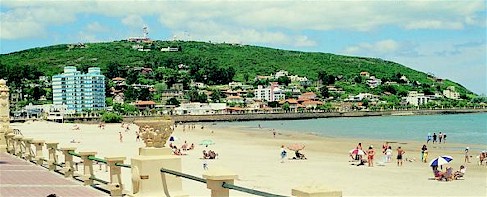 Uruguay is probably one of the randomest places I've ever been. (Well, maybe second place after Slovakia.) Not random because of any particular characteristic of the place itself, but more because it's one of those places no one I know has ever gone, and before getting here I had no idea what to expect. ( Of course Uruguay, like Slovakia, is extremely popular with tourists from bordering countries, but Canadian tourists are fewer and farther between.)
  But I sort of like going to places where I have no expectations. Like, you go to Paris or London or New York, and you have a bit of an idea what the place looks like, and the kind of things you can end up seeing. And if it's not the way you imagined it, then you may be disappointed. But who's going to say to themself, "Wow, Strsbké Pleso is NOTHING like it is in the movies, what a disappointment!"
Anyway, so here I am in Piriápolis, Uruguay, which is about 100km from Montevideo, the capital. It's on the Atlantic coast of Uruguay, aka the Gold Coast, which is lined with beaches for about 400km from Montevideo to the Brazilian border. The beaches aren't anything like tropical Caribbean beaches, or even like those found in Brazil, but they've got white sand and warmer water than the beaches in Argentina, Chile or Northern Nova Scotia.
At the last minute my German friend Martina decided to play hooky from the hospital where she's studying medecine in Buenos Aires and come with me. It's over 30C and like 110% humidity in Bs As so it wasn't too hard to convince her she needed to get out of the big city and get some ocean air.
After a heartattack-inducing close call getting on to the ferry, we made the 3 hour trip across the Río de la Plata from Buenos Aires to Colonia, Uruguay, and then took a bus to Montevideo and another bus to Piriápolis. It's a beach town, no doubt about it. Tons of hotels, touristy stores, and cheezy restaurants. But the high season doesn't start until January, so right now it's blissfully empty and quiet, and the prices are lower. We managed to just show up and find ourselves a very cheap and nice hotel, which I think would be impossible during the high season.
Today we spent the day on the beach. Really, just swimming, laying around, reading trashy magazines and eating snacks. One day and my only day, because as usual, despite the artistic and masterful job I did coating myself with sunscreen I managed to get burnt to a crisp. No really, all I need is a dog was trying to pull my pants off and I'd be the Waterbabies sunscreen girl. Damn you Scottish heritage! But tomorrow we're going to hike up Uruguay's 3rd tallest hills and eat some seafood emapanadas, so all is well.
Wednesday, December 13, 2006
Off to Uruguay!
Tomorrow I'm leaving for a long weekend in Uruguay. I'm taking the ferry from Buenos Aires to Colonia, then I'll travel by bus to Montevideo, and to a beach of some sort. There are lots of different beaches, ranging from seaside resorts with highrises all along the water to really deserted coves where you can see whales and other wildlife. I'll have to see what I'm in the mood for. I'll be really happy to be by the ocean for a little while. And also, to see what Uruguay's all about. If you ask a porteño, Uruguayn culture's no different than Argentinian culture, and they consider the country bsically an extension of Argentina. But heh, heh, we've heard that one before, eh? Canada being the 51st state of the US and all? So I'll have to ask a Uruguayan their opinion on the subject...
Subscribe to:
Posts (Atom)
