I've been busy these last days. I sent out my resume to a bunch of language institutes, trying to pick up a bit of work as an English teacher. I've had a couple of interviews, and have a couple more at the end of this week.
My first interview was last Friday. I took the commuter train out into the suburbs to meet the director of a school.
Now, in Canada, suburb usually equals affluent, as compared to the more rundown centres of a lot of cities. But here, though there are well-off suburbs, many lower and middle class folk simply can't afford to live in the city, but that's where all the work is. So they live north of the city and take the train in each day. The particular train I had to take Friday has a bad reputation, as it goes through a bunch of neighbourhoods many would label unsavoury. As many did; I asked a few different Argentine friends about the train and they all warned me, don't take much money, keep an even closer eye on your bag than you usually do, don't talk to anyone, don't use your cell phone because someone will grab it out of your hand, don't sit in the cars at the ends of the train. One friend even offered to accompany me.
I took all the precautions, and in the end the ride was fine. And it was interesting for me to see the way that, like it or not, the vast majority of the citizens of Buenos Aires actually live. It's easy to forget, living on the edge of Barrio Norte/Recoleta, that it's really only a small minority of people that can afford to shop at the boutiques on Avenida Santa Fe a block from my place. And travelling by train, as opposed to road, in any country, is great. Roads are the main arteries of the modern city. But train tracks go through people's back yards and woods and through nooks and crannies and out of the way areas. Whether it's the seedy underbelly or an idyllic hidden green space, on the train you get to see more than simple storefronts and housing facades.
So, I get of the train, and go for the interview in...a Burger King! It was seriously, the best interview ever. The director of the institute, and American woman who's lived here for 10 years, met me in jeans...with her Argentine husband and her 9-month old baby. They were like, "If the baby likes you, then you've got the job." So I frigging summoned all my baby-pleasing skills and as soon as you know it, he's smiling at me and giggling and trying to hold my hand. and they're like, " Oh my god, he loves you! You'll be such a good mother someday! Oh my god!" Oh yeah, and then we talked about, like, my resume and experience for a sec. After they went on about how much they love everyone from Nova Scotia.
And then she gave me a bunch of classes. I had my first one this morning! I had actually forgotten I how much I liked teaching English. The student I had this morning works in this uber-chic, hip, expensive hotel in PuertoMadero that is in a converted factory. She's going to give me a tour next week!
Gotta go prepare tomorrow's class!
Tuesday, November 07, 2006

Thursday, November 02, 2006
Mercedes Sosa
Seeing Mercedes Sosa live would be great. Seeing Mercedes Sosa live in Argentina would be even better. Seeing her live at the Teatro Colon? Amazing. And seeing her live at the Colon in the last concert before the theatre closes for a year of repairs? Oh my god. And that's what we did last night.
Mercedes Sosa is an Argentinian singer, famous around the world and beloved in Argentina for her interpretations of Argentinian folk music, nueva canción, and collaboration with some of the most important artists in Latin America. She has a huge, rich alto voice and a unique interpretive style.
A group of us, Stefan and Patricia from Germany, Marie-Christine from Quebec, Cameron from Chigago, Martin from Northern Argentina and me, got $4 standing room tickets for Mercedes Sosa's concert last night at the Teatro Colón. We got there early, knowing what an occasion the sold-out show would be.
She's in her 70's and has had heart and hip problems, so she did the whole show seated. this didn't effect her stage presence and musical command one bit, though. Her huge voice filled the Colón.
She was accompanied for the first half of the show by a small ensemble of piano, bass, and drums, with some guest musicians on guitar, bandoneón, and guest vocals for certain songs. For the second half of the show the Orquesta Simfonica del Teatro Colón joined her on stage. Though the musicians' performances and arrangements in the first half were great, I thought the power and sound of an orchestra to be a more adequate support for Mercedes Sosa's tremendous voice.
The show was awesome. She sang a wide variety of repertoire, from a couple of folkloric chacateras from her native province of Tucumán, to a song by Silvio Rodriguez and one by Astor Piazzolla. And everyone in the sold out hall was so into it.
As she precariously stood up and performed the last verse of the last song of the show standing, the crowd followed her lead, and the house went wild with applause, whistles, and bravos. And I thought the applause after the opera was wild; it was nothing compared to the sold-out house's appreciation of one of the country's most beloved and respected musicians. As she and the orchestra left the stage after the encore, everyone continued to clap and sing, wanting more. As the woman beside me commented, "I'd stay here till 3 in the morning if there was the possibility she'd come back out and do another song!"
What a show. Some of our group knew Mercedes Sosa only by name, one girl had never even heard of her at all. Buit everyone was totally moved by the concert.
And now the Teatro Colón's closed. They're renovating it and the theatre will reopen in 2008, in time for its 100th anniversary celebrations.
Monday, October 30, 2006
Uh...Halloween
 This is a post on the phenomenon of Hallowe'en, or rather, the lack thereof, in Buenos Aires. (Really, though, it's just an excuse to post this picture of my brother Mark dressed up as Bill Cosby for Hallowe'en. )
Hallowe'en doesn't really exist here. The only places I've seen with orange and black decorations are American chain restaurants. The only people that have Hallowe'en parties are ex-pats. And it's Spring here, so all the Hallowe'en related stuff is just so out of context.
Speaking of American chain restaurants, yesteday I was walking around Puerto Madero, the chic, new, slick, upscale neighbourhood that has recently been developed in what used to be the industrial port. It's pretty nice; there's all these fancy restaurants along the water in what used to be old warehouses. But, thrown in amongst all these fancy places are some random American chains, like TGI Fridays and frigging HOOTERS, pretending to be all fancy and stuff. And since no one here knows that these places aren't indeed fancy in their American incarnations, and get dressed up to go there, they effectively become fancy. Strange.
But, HOOTERS? I explained to the Argentinian friend I was with what the concept is and what the name refers to, and he was like, "So the waitresses just wear tight shirts and stuff? Like, what's the big deal? So does everyone in the street. Is the food good?"
Saturday, October 28, 2006
I think this would be illegal in Canada
So last night I'm having a drink with a friend, sitting on the outdoor terrasse of a bar. We were in a part of Palermo Soho where there's like a mini-rotary with a little plaza and a playground in the middle, and all around it are bars and restaurants, most of which have patios out on the street.
Over the course of the evening several people approached our table - people selling everything from glow in the dark headbands to homemade scented massage oil to kids asking for change. So when this woman came up to our table and tipped an open pack of cigarettes toward us and asked if we wanted one, we were like, "No, thanks.." assuming she was selling them.
But then a closer look at her flourescent blue spandex pants and sequined jacket and purse, all emblazoned with the Pall Mall logo, clued us in. She worked for the Pall Mall Cigarette company, and as a promotion for their new Light brand or something, they were going to bars and giving away free cigarettes, getting people to try the new brand. After you took the cigarette and tried it, another Pall Mall girl came around with a survey, asking you what you thought of it, and asking for your name and address, so they could send you invites to special events, or something like that. Uh...yeah.
Pretty friggin' sketch, eh?
Thursday, October 26, 2006
Madres de la Plaza de Mayo
 I just came back from the Plaza de Mayo, one of the main squares in downtown Bs As. Every Thursday at 3:30pm, a group called the Madres de la Plaza de Mayo take over the square with a political march.
In a nutshell, the group came about during the dictatorship, when the mothers of men and women who had mysteriously "disappeared" in the middle of the night decided to take action. They started regularly protesting, demanding justice and the safe return of their children, in the Plaza de Mayo, white kerchiefs the "uniform" of their ranks. Since the dictatorship ended, the group has continued to be active in various social justice and human rights related causes.
The Madres are very well respected and are famous around the world. Their weekly march is, I learned today, a big tourist attraction. There were tons of foreigners there with digital cameras, filming, or just taking in the march.
But I felt mixed feelings watching the march today. On one hand, the fact that so many tourists are interested by the Madres, a political group fighting for social justice, is a good thing. Ideally learning about the Madres, snapping their picture, and taking that story back to your home country helps promote their cause - it's not the same kind of tourist attraction as the Recoleta Craft Fair or the beach at Mar del Plata.
But it was sort of weird. The Madres silently circle the statue in the centre of the Plaza. And there's tourists with their cameras everywhere; people taking pictures from afar, people walking backwards in front of the group to take a shot from the front, people going up amongst the women and taking pictures from there... One girl standing at the little table the Madres have set up with pamphlets and things, right in the woman's face with her digital camera, not taking a pamphlet or talking to her, but simply capturing her "quaint kerchiefed-ness" on film. And everyone else is standing around the plaza, just watching them walk.
Now, it's not meant to be a loud protest, and I don't even know how it's seen to just join into the march. But it still seemed really strange to me that everyone's standing around casually snapping pictures of these women and this march whose movement has deep roots in the dirty past of this country and is heavy with signification.
The whole scene just struck me as sort of weird. Are the Madres really no more than some kind of tourist attraction?
Tuesday, October 24, 2006
Teatro Colon
 Could you imagine a group of Canadian elementary schoolchildren being taken to an opera house as a school trip? So important is the Teatro Colón in the history and cultural life of Buenos Aires that every time I go past there are at least a couple busses full of students or tour groups waiting to go in for a tour.
Mussorsgky's opera Boris Godunov opened last week, and so I thought it a good excuse to check out this landmark, not only because it's the last opera of the season, but that at the end of the season the Colón closes one year for repairs.
Waiting in the huge line to get a ticket didn't bother me - seeing so many people interested in c
 lassical music was a nice change from all those concerts I've been too where the audience consisted of 5 old ladies knitting in the back. But the guy at the box office told me the only tickets left for this Sunday's matinée were crap seats where I wouldn't see anything. So I decided to go for an entrada a pie, a $4 ticket in the standing section at the back of each of the three upper balconies.
Sunday afternoon I scrounged together something resembling "nice" from my collection of backpacker clothes and made my way to the theatre. As I climbed the stairs and entered the Cazuela level, I realized how much of a standing section novice I was. The best standing spots, at the centre back, had been claimed by people who had obviously arrived WAY earlier than I did, and who were fully equipped with little chairs and stools. I duly took my place at the end of the row, on the side.
As the show started, I fidgeted around, trying to see around unfortunately placed posts and peoples heads, and trying to take in both the stage and the Spanish supertitles of the Russian text at the same time. A decorative moulding hanging from the ceiling which must look quite lovely, but which partially blocked my view, meant that I had assume a stooped over position. ( Of course, this wasn't an issue for all the other petite Argentine ladies in the section. This must have been punishment for my tall frame blocking the view of everyone behind me at some outdoor concert or something...) In between acts, when one of the patrons who had paid for a seat but they'd had enough Russian and didn't make it back after the break, there was a mad dash for the empty chair.
It sounds uncomfortable, but it wasn't actually that bad. In the intermissions, I'd sneak down and take a rest in someone's plush seat, taking in the gorgeous, decadent interior of the theatre at the same time. And the production was pretty good and enjoyable, despite the soloists' distracting habit of coming out for a bow during scene changes, breaking character and the mood of the story.
And at the Colón, do not, I repeat do not, whisper to your neighbour, open a candy, let your cell phone ring, or start to clap at the end of an aria before the conductor has released the last note, or you will be greeted by the loudest "ssssshhhhhhhhhh" you've ever heard. From three levels up I heard someone down on the lower level start to clap at the wrong time and in unison a perfectly coordinated chorus of "shhhhhhhhh" from all levels reverberated throughout the hall. Dirty looks just don't cut it in Buenos Aires.
And when the opera ended, I thought I was at a football game, the way everyone started to freak out. With the typical Argentine lust for life, the audience erupted into applause, cheers, whistles, screams, and shouts of 'bravo', for like 20 minutes. But seriously, they were FREAKING OUT. A far cry from the restrained applause following a Canadian opera, but sort of cool, you know?
Monday, October 23, 2006
At the theatre
One of the great things about Buenos Aires is that it's one of the cultural capitals of South America. There's tons of cultural activity - concerts of all types of music, theatre, dance, galleries - and it's pretty accessible, unlike in Santiago where shows can be pretty expensive.
 This weekend I decided to start dipping my toes into the cultural waters. I had seen a poster in the Subte for a documentary called Rio Arriba, that caught my eye because it took place in the communities north of Salta where I just visited. It tells the story of a young Argentine whose grandfather was owner of Salta's San Isidro Sugar Plant. Though now most are closed or automated, sugar used to be one of the region's, and the country's, important industries. But the plant owners culled their workforce from small aboriginal villages in the nearby Andes, practically forcing them to work hand-cutting sugar cane in back-breaking conditions and for pay that was less than ideal. And in the process, the aboriginal communities abandoned the traditional way of life they had known for centuries. The kind of story of exploitation of minorites for the sake of development that can be found in countless places around the globe. But what was interesting for me as a foreigner was learing about this particular incident in the context of Argentina. And the filmmaker told the story in a very personal way; his being the grandson of one of the men responsable for such exploitation, the film was structured around his coming to terms with his family history through the visiting of aborignal communites and farms and hearing the stories of those who had worked on the plantations.
Saturday night Jessica and her boyfriend Manú and I checked out a play called Isla Desierta by the Teatro Ciego at the Ciudad Cultural Konex. The Konex is this huge cultural complex converted from an old factory in an industrial part of town. There are a couple of theatre spaces, a cafe, a gallery, a huge outdoor space where they have festivals in the summer. They've really kept the rugged unfinished feel of the factory, and the spaces are huge.
Teatro Ciego means "blind theatre", and what was cool about the piece, besides the fact that some of the actors are blind, is that it all happened in the dark. Pitch dark. You enter the theatre in pairs, hands on the shoulders of one of the actors, and you go through a long passageway, through a some curtains, and then you are led to your seat. And there's not one speck of light - you can't see your hand in front of your face. And then the play starts, but everything happens in the dark, and the plot unfolds through dialogue, live sound effects, music, odours, sensations... The story was nothing extraordinary; a group of office workers on the 10th floor of a tower near the city port, who dream of travelling on one of the boats that continually enter and leave the harbour. One guy has travelled, and so he tells the stories of his travels to the group. As he recounts his adventures at sea, in China, and in the jungle, each of these worlds is created by the actors using all the senses except sight. I don't know how they did it, but they recreated live the sounds of a rowboat rowing through the water, people swimming ashore; they made a thunderstorm using some kind of fan and mist and when he arrived in China all of sudden you smelled what could only be what a busy Chinese street smells like.
My only complaint was that the story ended really abruptly and they flicked on the lights and you saw the actors and the theatre space, which everyone had imagined in their own way. It would have been nicer for the story to gradually wind down and the lights to come up slowly. The coolest part was less the story, though, and more the being in complete darkness.
While at the Konex I also picked up tickets for an aerial dance piece (!) for next Friday night. Cool!
 This weekend I decided to start dipping my toes into the cultural waters. I had seen a poster in the Subte for a documentary called Rio Arriba, that caught my eye because it took place in the communities north of Salta where I just visited. It tells the story of a young Argentine whose grandfather was owner of Salta's San Isidro Sugar Plant. Though now most are closed or automated, sugar used to be one of the region's, and the country's, important industries. But the plant owners culled their workforce from small aboriginal villages in the nearby Andes, practically forcing them to work hand-cutting sugar cane in back-breaking conditions and for pay that was less than ideal. And in the process, the aboriginal communities abandoned the traditional way of life they had known for centuries. The kind of story of exploitation of minorites for the sake of development that can be found in countless places around the globe. But what was interesting for me as a foreigner was learing about this particular incident in the context of Argentina. And the filmmaker told the story in a very personal way; his being the grandson of one of the men responsable for such exploitation, the film was structured around his coming to terms with his family history through the visiting of aborignal communites and farms and hearing the stories of those who had worked on the plantations.
Saturday night Jessica and her boyfriend Manú and I checked out a play called Isla Desierta by the Teatro Ciego at the Ciudad Cultural Konex. The Konex is this huge cultural complex converted from an old factory in an industrial part of town. There are a couple of theatre spaces, a cafe, a gallery, a huge outdoor space where they have festivals in the summer. They've really kept the rugged unfinished feel of the factory, and the spaces are huge.
Teatro Ciego means "blind theatre", and what was cool about the piece, besides the fact that some of the actors are blind, is that it all happened in the dark. Pitch dark. You enter the theatre in pairs, hands on the shoulders of one of the actors, and you go through a long passageway, through a some curtains, and then you are led to your seat. And there's not one speck of light - you can't see your hand in front of your face. And then the play starts, but everything happens in the dark, and the plot unfolds through dialogue, live sound effects, music, odours, sensations... The story was nothing extraordinary; a group of office workers on the 10th floor of a tower near the city port, who dream of travelling on one of the boats that continually enter and leave the harbour. One guy has travelled, and so he tells the stories of his travels to the group. As he recounts his adventures at sea, in China, and in the jungle, each of these worlds is created by the actors using all the senses except sight. I don't know how they did it, but they recreated live the sounds of a rowboat rowing through the water, people swimming ashore; they made a thunderstorm using some kind of fan and mist and when he arrived in China all of sudden you smelled what could only be what a busy Chinese street smells like.
My only complaint was that the story ended really abruptly and they flicked on the lights and you saw the actors and the theatre space, which everyone had imagined in their own way. It would have been nicer for the story to gradually wind down and the lights to come up slowly. The coolest part was less the story, though, and more the being in complete darkness.
While at the Konex I also picked up tickets for an aerial dance piece (!) for next Friday night. Cool!
Thursday, October 19, 2006
I have joined the 20th..uh...21st century
I have something to announce. I just bought a CELL PHONE. Oh my god! Who'd have imagined that I would finally embrace the technology that inspires so much horrible social behaviour in normally intelligent people. But seeing as I'm living in a hostel with shared phone that doesn't work that well and that cell phones are SUPER cheap and rampant here ( mine cost $40 and came with a $20 prepaid credit), I gave in. It'll make life easier.
The slick, metrosexual yet somehow still very macho cell phone salesman that sold it to me set it up with a ring tone of some British pop song that had very vulgar lyrics. He told me I thought I'd like it because it's in English. Then he asked me to explain the lyrics to him and I was like, "Um, your mother wouldn't approve." Then the other salesguy told me that there was a special on today; buy a phone and get the salesman's number for free. Ah, Argentina.
Gotta go find a church or public restroom or something to test out my new phone.
Cara de Queso
 Yesterday I felt like giving my Spanish a run with a subtitle-free movie. And obviously, I wanted to choose something local. I had seen some posters around town for a movie called Cara de Queso , which looked sufficiently funny and light to not be too hard for a non-Spanish speaker, so I decided to go for it.
At first glance, from the poster, it looked like some sort of Spanish Napoleon Dynamite rip-off. But it was far from it.
It as the story of a young Jewish boy named Ariel from Buenos Aires. Every summer his family escapes the heat of the city at their country, which is the Spanish word borrowed from English describing, from what I can gather, something like a country club slash gated community slash family summer camp. You have your golf course, pools, sports facilities, organized activites, etc, like in a country club, but there are a bunch of houses there, where people live for the summer. Sort of like a summer cottage, but not necessarily in the middle of the woods or on the beach. The particular country featured in the film was an exclusive Jewish club for Jewish families only.
The film underlines the parallel between the Jewish ghettos that used to exist in Eastern Europe and the self-created Jewish ghettos, such as this country club, that exist today. Though it was basically a mid- 90's coming of age story of this pre-teen boy and the wacky antics of him and his gang of friends, there were themes of exclusion and inclusion and abuse of power and being a minory woven throughout. So it was a little more enriching than your typical teen movie. Which showed in the crowd that came to see it, which included many middle-aged members of the very Buenos Aires Jewish community that the film examines.
(And in movie theatres here, you get an assigned seat! Of course, some old man was sitting in my seat, so I had to sit in someone else's seat...chaos could have ensued, but thankfully the theatre wasn't full...)
Monday, October 16, 2006
Recoleta
Now that I've resolved the problem of where to live, I can get onto really seeing this city. Today is a holiday here, so I've been wandering around Recoleta, taking in the big craft fair that takes place on weekends here. The grassy knolls that surround the craft stalls are filled with people sun bathing, hanging out, and drinking mate.
 I also took a walk through the Recoleta Cemetery, where the who's who of Argentine politics and society is buried. But unlike any cemetery I've seen, instead of everyone being buried in theground and the grave marked with stones, every plot is actually a little mausoleum, with the coffins inside. Eerything's organized into aisles and rows, so the effect is like walking through this mini town, the mausoleums resembling mini houses seperated by narrow little streets.
The mausoleums vary in levels of ornateness and decoration, some being quite simple and somber and some decked out with crosses, statues, and domed roofs. Not being that familiar with Argentina's historical figures, what clued me into the fact that the people buried here are important are the last names, which are the names of streets not just in Buenos Aires but in every town in Argentina. Just like every town in Quebec has it's Rue Laurier or Rene Levesque, every town here has a Caseros, Sarmiento, San Martin, and the list goes on. they must have done something important.
I have a home
So, I finally found a place to live. If you are willing to pay out your arse, you can easily find somewhere to stay. But if you want to keep a budget, trying to find a place that's the right combination of nice, well-located and cheap can be a bit more challenging.
So after a week of making calls and visiting places, I moved into my new place Saturday. I have a little room in this hostel/boarding house on the edge of the Recoleta neighbourhood. It's this huge, crumbling old house, with three floors, several bathrooms and kitchens, and all kinds of nooks and crannies. The people that live there are a combination of international students staying for a couple of months, and travellers passing through. It's in a great location, close to downtown, the subway, and the chichi upscale neighbourhood of Recoleta, just in case I get an urge to buy some designer shoes. Oh yeah, and it's a short walk to the Teatro Colon, Buenos Aires' beautiful world-famous opera house and concert hall. My room's extremely basic, as are all the facilties, but the place makes up for it in its friendly atmosphere. The owner's this friendly Chilean-American ex-wannabe rockstar from LA who moved here 7 years ago to open the hostel.
I'd just moved my stuff in and was looking forward to a quiet night in, when this group of German guys having a drink on the patio invited me down. They had all studied here in Buenos Aires 4 years ago, one of them having lived in the hostel, and they had organized a reunion, and were going out to meet some of their old classmates and friends. So I tagged along.
They told me stories from back in the day of their wacky exchange student antics: How one of them only used to date girls with names that were also song names - he dated a Cecilia, a Lola, a Macarena and a Roxanne; How they once borrowed ties and suits and tagged along to the family wedding of the Argentinian girl one of them was dating and Grandpa still talks to this day about their crazy dancing styles; And how their time in Buenos Aires conincided with the economic crisis of 2001, and how they got to live first hand one of the most intense moments in modern Argentine history.
After a dinner of meat, meat and more meat, we went out for a drink in this bar called Milion. It's a huge multi-storey mansion that's been converted into a bar and restaurant. There was this interactive art exhibit going on, sponsored by Lucky Strike Cigarettes - (it's not just in Canada where tobacco companies sponsor cultural events.) There were all these installations set up with infrared lights; the tables had been covered with some kind of plastic that absorbed the light, so you could draw, with light, on the table with these pendulums hanging down from the ceiling. There was also this race track set up, the surface made of the same special plastic, and the wheels of the car setup with infrared bulbs, so that wherever the car went, it left this trace of light. Cool! A nice distraction in between Mojito Margaritas (whoever invented this drink is a genius.)
Of course, in typical Argentinian fashion, we left the bar at 2:30am and they all hailed a cab to continue the night out at a dance club. I'm still adjusting to 3am not meaning last call, so I went home.
Tomorrow my classes
Friday, October 13, 2006
El cuerpo del deseo
The last couple of days have been filled up with running around looking at places to live. I sure have gotten to see a lot of the city in the process. I'm going now to get the keys for the place where I'd like to live, but let's not talk about it now- don't want to jinx it.
Anyway, but I have had the chance to watch a bit of Argentinian TV. Now, I know it sounds lame to be sitting around watching TV while in Buenos Aires, but I have to admit it is a good way of practicing my Spanish. And since they don't show Chilean soaps here, I have to fill the void left by Complices.
 Apart from the Argentinian remake of Married with Children ( Casados con hijos) that's really popular here right now ( seriously - and the Argentinian actress playing the daughter really looks like Christina Applegate), they're heavily promoting this soap operas called El Cuerpo del Deseo, which starts this Tuesday. The ads are so incredibly cheezy and hilarious, that I had to do a web search to find out what it's all about. Turns out it's a Columbian series they're remaking for Argentina. Here's the description, from the IMDB:
What person over 50 or 60 hasn't fantasized about being young again with all his knowledge intact? EL CUERPO DEL DESEO is about that and more.
Just as LA MUJER EN EL ESPEJO explored issues of beauty, EL CUERPO DEL DESEO explores issues of age, wealth, and power. The wealthy but aged Pedro José Donoso marries a beautiful but greedy young woman who already has a lover on the side. He has dreams about a strong young man performing heavy farm work and every time he wakes from these dreams he feels even more intensely that he has experienced them. He dies suddenly in his study one night, and the young farmer also dies within hours. However, Pedro José's spirit refuses to give up and enters the young farmer's body as it is being carried to the cemetery. When he breaks out of the coffin and is brought to a medical facility no one can explain what happened… and he is more confused than the others. He freaks out the people around him by displaying knowledge and abilities the young farmer never had. He is greatly confused as to what has happened and why. He gradually learns that the reason for this strange phenomenon is to learn the truth about what has been going on under his nose and behind his back. He then has to make a decision about what to do about it all.
The studly Mario Cimarro of PASIÓN DE GAVILANES is more than worthy of this acting challenge as he explores what it is to be what to all intent and purposes is an impostor. The scene in which he strips in front of a mirror and sees his new handsome face and perfect body is priceless; he manages to convey the humor, the irony, and the apprehension all at once. We later see the dark side of his personality as he uncovers the deceptions and hypocrisies around him. The beautiful Lorena Rojas, who also sings the theme song, is flawless as the greedy "widow" Isabella, while Martin Karpan of TE VOY A ENSEÑAR A QUERER is increasingly sinister as her controlling lover.
Hilarious!!! I can't wait to start watching it.
Wednesday, October 11, 2006
Linea A
The last couple of days I've been busy trying to find a place to live and trying to register for my Spanish class. Registration was this morning between 10am and 12pm, they told me when I stopped by the faculty for info the other day. So, I arrive at 10am and there's this huge line. I wait in line for an hour for them to give me a little slip of paper and tell me to come back at 5pm. Little did I know yes, registration started at 10am, but people came and started lining up at 8am. Of course they didn't mention that when I came by for information.
In the line I was chatting with this German girl and we were like, "This is so disorganized! Why did we have to wait an hour for a piece of paper? Why didn't they just hand it to us when we arrived? Why is there only one girl handing out the pieces of paper? Why did the Argentinian guy in front of us who went up and yelled at the girl get to whisk his foreigner girlfriend through they line and into the placement test? It would be so simple to organize this better.."
And then we looked at each other and were like, " Oh my God we're SO German and Canadian! We can't handle this lack of organization. We have to relax or it's going to be a long two months here in Argentina..." Of course then we went for a coffee and the waiter messed up our order and then ignored us when we asked him to fix it.
 But my unexpected 6 hours to kill have given me some time to do something I've been wanting to do: ride the Subway Line A. Line A of Buenos Aires' Subway system ( El Subte) has wooden-panelled cars dating from way back, complete with dim lamps and doors you have to manually open yourself. One of the stations on the line, Peru, has been refurbished to look like it would have back in the day, with tiled walls and floors and advertisements from the 30's. My travel book described riding on Line A as rumbling down the tracks inside an old wooden wardrobe, and I have to say it's a pretty apt description. Well, maybe more like a wardrobe filled with businessmen commuting and youngsters listening to their iPods.
Monday, October 09, 2006
Buenos Aires!
I've now been in the capital for two days. It's a HUGE city. Well, bigger than Montreal in any case, at something like 5 million people ( 15 million if you take in the whole greater Buenos Aires area). But its hugeness is less about numbers and more about it feeling really big. I spent the day wandering down the heart of downtown; the avenues are, like, 10 lanes wide, the buildings are tall, and every street in the centre is just packed with people. And you have everything from the old grandma selling homemade empanadas for $.30 from her hole-in-the-wall storefront, like in Salta and Córdoba, to the Adidas superstore and the Zara outlet, with prices that match those in Canada, which you definitely didn't see in the other places I've visited.
 Though I know that throughout my two months here I will constantly be discovering parts of the city, yesterday I dove headfirst into one of the most iconic parts of the city, San Telmo. It's a neighbourhood of crumbling ornate buildings and narrow cobblestone streets. On weekends a bunch of the streets are blocked off to car traffic and so the whole area is filled with street performers and people selling crafts and antiques and pop corn and just about anything you can imagine.
Jessica, (the Chilean friend with whom I'm staying for a couple of days), and I took the micro across town to San Telmo from her apartment in Palermo. We had a late lunch on the terrasse of a cavernous old restaurant ( I ordered mashed pumpkin, to celebrate Thanksgiving) and then just wandered around for the rest of the afternoon. Wanderings punctuated by street-side tango shows of varying quality, ice cream cones, and playing "wow, that would make a great souvenir if only I wasn't carrying all my worldly possesions across the continent in an already bulging backpack."
My Spanish classes start Thursday. Now I just have to find a place to live...
Saturday, October 07, 2006
Córdoba Nightlife
Yesterday night, after a strenuous day of wandering aimlessly around Córdoba's historic downtown, I went out with Simon, Jimena's sister Augustina (a.k.a GuGu) and her Brazilian friend Felipe. At about 10:30pm we went for supper at this neat little place called Alfonsito - good food, and nice atmosphere. Lots of random and interesting stuff hanging from the walls.
And then we wanted to go for a drink somewhere. It was about midnight. But you see, in Argentina, the bars don't start to fill up until about1:30am or 2. And when people go out, they stay out until the sun comes up. It's actually not that bad of a system. You can come home in the evening, take a nap until about midnight, and then get up and go out until 7am. It just takes some getting used to.
So we checked out a couple of places, but it being only around midnight, they were completely empty - not a soul to be seen. But we decided to be those first early-comers and went into a bar called Club 990. This big, cavernous place with cement floors and sort of a mildly hippy reggae vibe - some pictures of Bob Marley on the walls, jazzy paint job, masks hanging on the walls, pool table... The guy at the door told us a rock band and a reggae band would be playing later.
So at about 2:30am the band takes the stage. And I seriously asked myself if Slayer were making a surprise underground performance. They were a metal band, playing super heavy stuff, and really loud. It was hilarious. These guys were INTO it. And more so than most of the people in the club; the clientele was more reggae than metal, and seemed just as peeved as us that the music was so loud it prohibited conversation. So after a couple of "songs" ( if you could call them that) we decided to call it a night.
And in an hour I get on the bus for Buenos Aires! Go east, young man!
Friday, October 06, 2006
Simon, Jimena and Manuel
My friend JO's sister set me up with some friends of hers who live here in Córdoba, and Wednesday night they invited me to their house for supper.
Simon's Québécois and Jimena's Argentinian and they met through the myriad of travels and student exchanges they've both done in South America and in Quebec. They had been living in Quebec, but came back to live here in Córdoba, Jimena's hometown, for a couple of years. They have an adorably cute one year old named Manuel.
We had a nice veggie dinner, a change from the constant intake of steak one gets used to in Argentina. Jimena's finishing a doctorate in Linguistics and Simon studied ESL education, so we had lots of interests in common. They also gave me a crash course in the last three decades of Rock Nacional, or Argentinian rock music. So now I know that though it's pronounced, "Espinetta", the classic singer's name is really spelled Spinetta. Good to know.
Quebrada de los Condoritos
I had been wondering why it had been so hard to find a place to stay in Córdoba. Usually, I just show up in a place, and call one of the hotels or hostels in my travel guide, and off I go. But Córdoba, I had to call 5 or 6 places, they were all full. Which was weird, because it's mid-week, and the off-season, and Córdoba's not exactly tourist destination #1. But I found out when the group with whom I was going hiking came to pick me up on Thursday morning; there is a pediatrician's conference in town, with 8000 doctors from all across the country attending seminars and the like. Two of the 3 other people in the group were pediatricians who had chosen to skip out on the day's proceedings in search of some fresh air. (I have to say, it's sort of reassuring to know you have two doctors along when you venture out into the wilderness...)
Martin, our tour guide ( complete with Argentinian mini-mullet) drove us in his little red truck the two hours on a twisting winding mountain road out to the Quebrada de los Condoritos national park. We were to hike 10km each way to this gorge with a combination of conditions that attracts Andean condors and their young, as well as all kinds of other birds of prey. The word condoritos in the title of the park refers to baby condors; the gorge being only a kilometre wide, it is the perfect place for condors to teach their young how to fly.
Now, I must admit that I'm not a huge animal buff. I mean, I think it's as cool as anyone to see a deer or moose or rabbit when I'm out hiking, but that's where it ends. And birds, well, they all look the same to me. So when I was inquiring about going out hiking and the only trip that was leaving this one, to see condors, I was like "Great, a bird-watching hike. Everyone will spend the whole trip polishing their binoculars and practicing their bird calls..."
But, condors are COOL! I was surprised. Their wing span is 3 meters, and they flap, like, once and glide for like 10 minutes. And when there's a bunch of them flying over you, it's quite impressive. And the hike was nice - through this exposed pampa grassland, and some small rocky hills. There were some nice views of the surrounding mountains and valleys. The long yellow pampa grass has this neat iridescent quality when it blows in the wind.
And of course, it was inevitable. I was asked, once again, the question I think I've been asked the most from the people I've met, after all the typical, " Where are you from, etc.." Remember the scene in Michael Moore's Bowling for Columbine, where, to show the cultural differences in attitudes towards guns and violence, Moore goes to Windsor, or something and, like, walks up and into someone's unlocked house? I've been asked SO MANY TIMES, "Do Canadians really leave their doors unlocked?" Bowling for Columbine must have been really popular here, either that or no one has seen any other Canadian movies. Oh wait, I did meet a couple of people who had seen Les Invasions Barbares, and wanted to know if that's what Canadian hospitals are really like, and if the labour unions really have that much influence...
Wednesday, October 04, 2006
Bus to Córdoba
It rained for the first time in two months the morning I left Salta and got on the bus for a 12 hour journey to Córdoba, Argentina's second-largest city. Thought it took me a couple of days to get into Salta's rhythm, I was sad to leave - I really like the vibe of the people and the city.
The bus ride was your usual, with movies blasting over the sound system, and bus attendant wisecracking into the PA system, and the driver pulling manouevres with a double-decker bus I wouldn't dare do with a Honda Civic. A highlight was when they put on a ( clearly pirated) DVD of the most low budget, cheeziest music videos by the worst reggaeton artists I've ever heard. The volume at ten, I think the pair of old ladies sitting across the aisle from me where scandalized by all the girls in bikinis in the videos.
I was on the top level of the double-decker, which gave me wonderful views of the mountains, and then the dusty plains we crossed as we made our way southeast. My seatmate was a guy who had just been visiting his mother and girlfriend in Tucumán, and was now making the 24 hour trek to the south of Argentina where he's stationed in the navy. Quite an interesting guy, with his 15 years in the navy, we talked about everything from the geography of Argentina and South America to world politics. From what I have observed, if there's one thing that seems to unite the Chileans and Argentinians I've chatted with, no matter what the age, sex or social class, it's an extreme distrust, sometimes brodering on rage, of American foreign policy.
I got into Cordóba at 11pm and have been spending the day wandering the streets and taking in the atmosphere in the city's central square.
Pitcures from Cachi!
 Well, the road can't go stright up the mountain, now can it? To get to the top you have to zig zag up slowly. Don't worry, I had Gravol with me.
 Here's a shot of the plains and the cacti in Parque Nacional los Cardones.

This is me on the Recta de Tin Tin, this stretch of road in the Chaco Salteno ( plains), that has nothing to do with Tin Tin the comic character, but rather the sound two stones from the region make when you hit them together.
Cachi!
Monday morning it was up early once again for a trip to Cachi, this little colonial town a couple hundred kilometres from Salta, once again through a variety of valleys, gorges and desert. The different landscapes around Salta are in some ways similar, but in some ways quite different. Depending on the altitude, different plats grow ( for example, cardones, a type of cactus, only grow between 2000 and 3000 metres), and each gorge has it's own palette of colours, depending on the minerals present in the rocks. But everything is quite dry. It hasn't rained in Salta for 2 months - summer is when their rains come.
I was pleasantly surprised when Alberto, the same tour guide I had on Friday, came to my door to pick me up. I was hoping that he would lead this trip, actually. What a character, very friendly, extremely knowledgable about the region, and always ready with a funny story about something. And he was the ultimate local, too, born and raised in Salta, and in love with the region. That said, I couldn't understand the funniest of his stories, because he'd break out into the Salteno dialect. The Spanish speakers would be laughing their heads off, and I'd just sort of like do that fake laugh you do when you don't really understand....
As we went around town picking up the other people for the trip, we stopped at one hotel and a middle aged woman and her elderly mother got in the van. I thought to myself, "Looks like we won't be doing anything too strenuous today..." But she turned out to be the sweetest old lady, sharp as a tack at 82 years old and 3500 metres of altitude, and hilarious. Some of her comments rivaled Alberto's in inappropriateness...
The downer of the group was this guy named Horacio, this annoying, pale, nasally-voiced guy from Buenos Aires that wouldn't stop making condescending comments about the region, the people and the landscape. And he wouldn't stop looking at his watch. Picture the equivalent of the uptight, snobby Torontonian on a tour in Nova Scotia, dissing the downhome tour guide for lack of class and wondering out loud why the region's so backward. I tried to ignore him as best I could and did my best not to accidentally open the door of the van and push as we rounded a sharp corner on the twisting mountain road. But even his annoying personality couldn't take away from the swesomeness of the landscapes.....
I haven't mentioned what we saw yet, because Virginia, one of the other people on the tour, sent me some photos she took with her digital camera! For some reason Blogger won't let me put them in this message, so I'll post them in a seperate post.
Monday, October 02, 2006
Day of rest
Sunday I set aside to sleep in, rest up after all these excursions into the mountains, and do laundry and other errands. After breakfast on a cafe terrasse on the Plaza de 9 Julio, I made my way to the currency exchange place. Closed. Then I went in search of the laundromat. Closed. Come to think of it, there were very few people in the streets and most businesses were closed. Now, I know that Argentinians are night owls, but it was 2pm - I thought people would be up and about.
It turns out Sunday really is a day of rest in Salta. And as I took a shortcut through the Parque San Martin on my way to the bus station, I realized that no one was downtown because everyone was at the park! It was packed with families, vendors selling crafts, food and even pirated DVD's, kids running around and couples making out on benches.
In the park's amphitheatre there was a concert of local folkloric dance and music going on. It was my first introduction to these styles and I have to say I thought it was awesome! The music is something similar to Chile's cueca, given it's shared historical and colonial roots, but with different instrumentation. And the dancers, in full costume, did a range of dances, from partner dances to something resembling step dances to something like square dances. The men were dressed in the Argentinian version of a cowboy - a cowboy-style hat, gaucho pants, and these tall leather boots. The women wore big skirts and simple tops. I stood in the crowd for a couple of hours ( I finally found the advantage of being a head taller than everyone else...).
Salinas Grandes, Quebrada del Toro
Saturday morning it was up at the crack of dawn again for another excursion into the countryside surrounding Salta. Good thing there's a rooster in the vicinity of the place I'm staying that I can hear from my room.
As I waited outside on the street at 7am to be picked up, I was introduced to a Salteño custom. As every car came down the street, it would flick its high beams. I was like, "What are they flicking their high beams for? It's light out. It's a one way street so there's no opposing traffic. Huh?" But as the day went on, when driving on tiny winding back roads, as cars passed each other drivers would either wave to each other, or flick their high beams to say "Hi!" So when I was being "flicked" at in the morning, it was just guys passing in cars being like " Hey there..." They were also probably letting me know that they could give me a ride, assuming that since I was standing by the side of the road I was waiting for a bus. People driving by a bus stop will often stop and see if you're going the same way as them and give you a lift if you want.
Anyway, so our guide, a young little guy named Eduardo, finally arrived. With me on the excursion were a rather quiet and boring couple from Patagonia and this middle-aged British guy named Chris, who didn't really speak or understand Spanish very well. Though it was nice to be able to chat effortlessly in English for a bit, his unabashed Anglo-ness got a little old after a while.
We drove up through Purmamarca, which I had visited the day previous, and then out came the coca leaf as we drove up this incedibly serpentine road up all these mountians to an elevation of more than 3000m. This is the reason why it's better to go on organized excursions around Salta as opposed to renting a car yourself. Besides the obvious advantage of having a guide who can tell you about everything you go by and who knows where they're going, they know how to drive on tiny twisting dirt roads and up mountains and in the desert. And they have heavy-duty vehicles that can handle the terrain.
 Or so I thought. We'd just finished visiting the Salinas Grandes, more than 200 square kilometres of desert-like salt flats, and were about 15km down a 70km stretch of rough dirt road in these deserted desert plains when the truck stalled. And then stalled again. " I don't like the sound of that," said Eduardo, and neither did I. We were seriously so in the middle of nowhere. There was nothing but desert, llamas and wide open sky for kilometres and kilometres around. And maybe a half dozen trucks go down the road a day and there's no electricity, et alone cell phone service, for kilometres.
So, inside my head, I'm trying to think how the apple I have in my backpack will sustain me for the two days we'll have to wait until a truck goes by. But after about 15 minutes of the men huddling around the open hood, they figured out it was a wire that had come loose on the bumpy dirt road, and so we headed on.
About 50 kilometres on we stopped for lunch of traditional food at this tiny village in the middle of the plains. Open plains for miles, with mountains in the distance on every side. We got a tour around the village - everything was made of adobe and we saw the animals that rpoduced the food we had just eaten.
We then drove a while more through the plains to San Antonio de los Cobres, a rather industrial village of 3500 that despite its idyllic location was pretty drab and ugly. I did pick up some sunglasses to repace the pair I lost ( They were $5 and they're Gucci! Really! That's what it said on the package!) at the general store and had a chat with the teenage boy working there at the same time, whom I assured that in Canada we don't speak Spanish, but rather English and French. ( I took his comment as a compliment on my Spanish abilities.)
As we drove back through more and more spectacular landscapes ( which are just to amazing to try to describe in) and the Quebrada del Toro as night fell, I realized I was really getting into Salta. It took a couple of days, but then it starts to grow on you.
Friday, September 29, 2006
Quebrada de Humahuaca
 I got picked up at 6:45am sharp this morning for a full-day excursion into the Quebrada de Humamuaca. This gorge runs for over a hundred kilometres, north of Salta, and I think it was declared some kind of international treasure of humanity or something. On the tour was me, a hilarious older couple from Buenos Aires, and our Salteño tour guide, Alberto, all in a 4x4 truck.
As we started to drive up into the gorge, Alberto bought a bag a coca leaves from a street vendor. Coca leaves - yup, the leaves from which cocaine happens to be produced and which also happens to be an important and traditional part of many South American cultures - are chewed to help reduce the effects of altitude sickness. You stuff a bunch in your mouth and put them in between your back teeth and the side of your mouth and just leave them there. But don't chew
 them - they're pretty bitter.
The Quebrada is a huge tourist attraction. But it's no Disney World - it's a tourist attraction because it's a frigging impressive natural wonder. And most of the tourists are Argentinians, so it doesn't really bother me at all.
As you get up into the gorge, tall desert mountains and arid-landscape rise up on either side of the road. There's the Cerro de
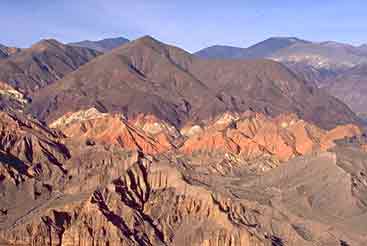 Siete Colores, where minerals and some kind of geological phenomea came together to create huge washes of different colours in the rock. There's the Pukara de Tilcara, the remnants of a pre-Incan fortress on the top of a huge hill. And then there are the villages of Purmamarca and Humahuaca, where local craftspeople sell their textiles, pottery and other crafts in the town plazas. A band playing Andean folk music played while we ate lunch.
I learned a whole bunch, took some great pictures (the ones on this site, aren't mine, BTW, thanks once again to Google Image Search) , but now I'm tired. Tomorrow it's off at 7am once again for another excursion...
Thursday, September 28, 2006
Culture shock in Salta
Shared the bottom floor of a double decker bus from Mendoza to Salta with a group of 6 backpackers I think were Dutch or maybe Swedish. The bus was full of backpackers- I met a couple of Irish girls and these two British guys on an around the world tour. Salta's a pretty popular destination for both domestic and international tourists, but since September's not really a popular time for Argentinians to travel, it's just us foreigners, on the busses, in the hostels, and on the tours.
We arrived in Salta about 1.5 hours late. Salta's way up north near the Bolivian border and both geographically and culturally, it seems a world away from Mendoza and Santiago ( and Buenos Aires too, I imagine). You can tell as soon as you get off the bus, simply by looking at the people's faces, that you're nearing Bolivia, it's a different ethnic makeup. And I feel taller than ever.
It's a smaller city, and it's a poorer city than those I've been to. So you have to adjust your instincts and intuition. When walking around a city you don't know, if you wander into a section that seems a little rundown, you know to be on your toes a little bit. But what if the whole city seems a little rundown, a little chaotic, becuase that's just the way it is? You can either be nervous the whole time, or readjust your instincts to fit the context.
I arrived in Salta this afternoon having barely slept on the bus overnight and having not eaten anything since the cup of tea and the cookie we got for breakfast on the bus. And I arrive at the residencial where I staying and it's not exactly the Sheraton, let's say. And then I wander around town trying to find something to eat at that weird time of the afternoon when it's too late for lunch and too early for supper. And the downtown's noisy and a little polluted. Overwhelming.
But I managed to set myself up with two tours into the amazing natural region that surounds Salta - one tomorrow to the Quebrada de Humahuaca to see crazy gorges and rock formations and Inca villages, and one Saturday to the Salina Grande, huge salt flats that are like a big white desert. And I realized from the amazingly hospitable reception of the little old lady and her middle-aged daughter that run the residencial where I'm staying - it's actually in their family home - that it's a bit rundown, but that's just the way they live. So I'll give it a try.
Wednesday, September 27, 2006
"Ya, po, huevon.."
I like being a linguist for more than it making a good topic of conversation at parties or knowing that my fellow linguists are some of the weirdest, nerdiest people in the whole world ( seriously- have you ever been to a linguist party?). It also means that I can be very easily entertained, almost anywhere, simply by sitting back and observing the way people talk. Because there's always something interesting going on.
Only having arrived in Argentina a couple of days ago, the language is one of the few striking differences between Argentina and Chile I've been able to observe.
When I was in Chile, everyone was like, "Why are you coming here to learn Spanish? Why don't you go to Peru/Columbia/Ecuador? Chileans speak fast and with too much slang." And it's true, Chileans speak really fast, and with a ton of slang. And they don't enunciate very well. But, as I would tell everyone, it doesn't really bother me. I sort of like trying to strain my brain to understand and trying to learn the Chilean expression for things. It's a fun challenge for me. But yeah, it means that a lot of the time, I have no clue what people are talking about when they talk amongst each other.
But actually, since most of my Spanish speaking friends in Montreal are Chilean, and having spent so much time in Chile relative to other countries, is that some of the words I've learned for things are local only to Chile, and I don't even know. Until I use one of them with a non-Chilean and they either laugh at me or look at me dumbfounded. Sort of like what happens when I start speaking Quebecois French with a French person because it's what I'm most used to speaking and forget to "Internationalize". I still have so much to learn.
There are tons of words and expression Chileans use, but one phenomena that I find hilarious is the use of huevon. Now, the word seems to come from the word huevo, or egg, but don't ask me what the link is, because it's used generally by the population to mean asshole or jerk or schmuck, according to context. There's a Chilean movei that's in cinemas right now called El rey de los huevones - King of the huevones.
What's really funny, though, is that young men literally tack it on to the end of every sentence when speaking to each other. (As far as I can tell, they don't really use it when talking to women, and women don't use it amongst themselves.) In this context, it doesn't really have an insulting connotation. They even tack it onto the end of the very Chilean "Ya, po", which is an affirmative answer to someone's question, which then becomes "Ya, po, huevon...". And when a bunch of young, drunken Chilean men are sitting around at a barbeque, conversing rapidfire and barely enunciating anything, you get something that sounds to my ears like: "hfjghfjghfjgh, huevon, fhgjfhgjfhgfj, huevon. dfhgjdfhgdjfghjdhg, huevon. Etc." I find it quite entertaining.
Argentinians speak differently. Their Spanish has a different rhythm to it. They don't use the same slang, and they have a really distinctive accent that everyone in the rest of South America makes fun of. And they don't use tu when addressing someone in the second person singular, they use another pronoun, vos, which has it's own distinctive corresponding verbal conjugations, which I can understand, but I don't quite have the hang of yet.
On the 17 hour bus ride I'm taking tonight to Salta, I'll have lots of time to observe.
Monday, September 25, 2006
Mendoza, Argentina
Mendoza, Argentina, has traditionally had close ties with Chile, given it's geography-it's just a hop over the Andes, and way closer to Santiago than to Buenos Aires. But national alliances prevail, especially in times of dictatorship, and only in the last while have Mendoza and Santiago started to rebuild their close ties.
And, despite the fact that there's a humonguous mountain range in between Chile and Argentina, there sure is a lot of traffic going back and forth. And yesterday was no exception, as I got on board a bus for the 7 hour journey from Santiago to Mendoza.
Intercity buses in Chile and Argentina are like a million times better than what we're used to in Canada. First of all, it's cheap ( my 7 hour international journey cost abou $16). Second of all, you have your choice of class- you can take a normal bus (clasico), or coche-cama, where the seats are bigger, and recline right out into beds. And even on the clasico buses, there's usually food or drinks served.
My seatmate was a chatty one- Rafael from Rosario. He's studying to be a bartender and he invited me to stay at his house if I go there. I traded him one of the empanadas I brought for lunch for one of his chocolate milks.
The best part about the bus ride is that YOU'RE CROSSING THE ANDES. Like, driving right over them. So for the 2.5 hours it takes to get to the border, which is right at the top of a mountain, you go through the foothills, and then finally a road that winds through the snowy mountaintops. And then you cross the border and wind through some more snowy mountaintops until you get to the foothills on the other side and finally to Mendoza.
Crossing the border is a huge hassle, though. If you're on a bus ( and there were about 10 other buses while we were there) you have to wait on the bus at the top for about 30 minutes, then everyone has to get off, line up to officially exit Chile with the Chilean border guards, then line up again to enter Argentina with the Argentinian border guards. Then they search the bus, inside and out, the motor, undeneath and everything, then they search all the checked luggage. The only person on our bus who they really searched was this little old Granny who seemed to have like, all the equipment for a full kitchen and presents for her 85 grandchildren in her suitcase.
All this procedure at the border is interspersed with much waiting around. The cool part is that you're surrounded by snowy mountains. As I waited I talked to this guy who was seriously the biggest hipster I've seen since outside Montreal. He had a shaved head and weird glasses and tight little jeans and a sweatshirt and jean jacket and sneakers. He was listening to music on these huge earphones, and was reading something intellectual. He was going to Buenos Aires to buy comics for his brother's comics store. I was like, "Haven't I run into you at Casa before?"
The most exciting part of the bus ride (besides the Lindsay Lohan movie) was when on the highway between the border and Mendoza, this car in the on-coming lane, for whatever reason, pulled a 180, screeching out into our lane. The bus driver McGyver-ed onto the shoulder, swearing like a sailor, and then pulled us back out onto the road. I don't even think he took his foot off the gas.
And so here I am in Argentina. This will be the last time I mention it, I promise, but it's SO CHEAP. I'm staying in this really nice hostel, right near the centre, with a shared kitchen and living room, with my own bedroom with a private bathroom. It's $11 a night! And that includes breakfast. AND my room has a bidet! ( Now I just have to, like, Google search to figure out how to use it...). We could go into the international politics of why Argentina's so cheap, and whether or not that's good in the long run for the country. But, for now, I'll just keep using my bidet and leaving big tips in the restaurants.
Since I've only been here a matter of hours, the most prominent observation I've made on Argentina after an afternoon of people watching is that the mullet is alive and well. Only amongst young men, though. And it's not really the full-out, super-cropped on the top and long and flowing down the back. It's like the Latin-Americanized mini-mullet, let's call it a mulletto. It's like a normal haircut, but at the back, it's just a little longer, just long enough to touch the collar, and maybe a little puffier too.
I'm here for a couple more days before heading north to Salta. But, in the words of Queen, I want to ride my bicycle, I want to ride my bike! So I think tomorrow I'll rent a bike and ride around the park!
Saturday, September 23, 2006
Mercado Central
 So, well, we were SUPPOSED to get up early and take the bus to Valparaiso, spend a day on the coast, walking around the beach, eating seafood, and walking up and down the hills that make up Valparaiso's centre. But, it jus didn't happen. We got to the bus station at 4pm, and decided it was a bit late for the 2.5 hour ride to the coast. We decided instead for a seafod feast at the Mercado Central, the place in Santiago to buy seafood, fruit and vegetables fresh from the different regions of Chile. Take a look at the map of Chile - don't forget how many
 thousands of kilometres of coastline there are in this country. And the variety and quality of the fish and seafood available reflects the geography.
The stalls in the centre of the market are ringed by a whole bunch of restaurants specializing in seafood, ranging from greasy snack-bar type places to swanky, high-quality etablishments.
As soon as you step into the vicinity of the market, you are accosted by representatives of the different restaurants, trying to persuade you that their restaurant is the best, and offering you free drinks and other discounts if you go to their restaurant. It doesn't stop when you get inside the market either. It's a place that attracts its fair share of tourists, too, so even once you've been seated at the restaurant of your choice, there are people circulating around offering to take your picture, musicians wandering around, people with puppets trying to make your kids laugh - all for tips, of course.
We stuffed our faces on clams, salmon, shellfish, and a refreshing white wine. And the pebre was fantastic! Pebre is this salsa-type spread that accompanies the bread at most Chilean meals, whether it be at home or in a restaurants. It's a mix of chopped up onions, tomatoes, garlic, cilantro, and sometimes with spicy additions like peppers and olives. Mmmm!
But it was my last pebre for a while. Tomorrow morning at 10am I take the 7-hour bus ride to Mendoza, Argentina. Hasta luego, Chile!
Complices
 I knew I wouldn't be able to escape Chile without taking on at least a couple of vices. I have a newfound love for manjar, the dulce de leche-like caramel that's in, like, every pastry and dessert here and can be bought by the litre in the supermarket. But more surprising is my love for the Chilean soap opera Complices.
The basis of the story is that this American guy named Harvey who has a ton of money came to Chile and for some reason that I don't quite grasp, had to recruit a whole bunch of Chileans to pretend to be his family, and has to pretend to have this big company, in order to keep his money. Coronation Street this is not. So all these people are pretending to be his extended family, and they can't let anyone know they're not. Add to that all the usual soap opera fare - affairs, drugs, crazy people, etc. - and you've got a hilarious, yet addictive show. And it's on at prime time!
The show's frigging hilarious. You thought bad acting, low production values and implausible plot twists were unique to American soap operas? No way - it turns out some things are universal. The best part is that Harvey, who has this horrible gringo accent and bad grammar, is played not by an American, but by this Chilean actor imitating the way an American would speak Spanish.
But it's somehow addicting, too. And since I've been laying low for the last couple of days with (another) cold, I've gotten to watch it a bunch of times. Though the plot sounds complicated, it's well put together in that you can just sit down and get into it knowing the minimum of the background. And I can actually understand most of the dialogue, for some reason. I find it harder to follow the dialogue on other TV shows and movies.
Tomorrow I'll get to find out what happens to Soledad, who's Harvey's sister ( but not really, they're faking it, remember?), who declared her love for Harvey today, and he loves her to, but is tormented because he doesn't want to show it because it will ruin the ruse. Oh my god!
Tuesday, September 19, 2006
Rio Clarillo

Monday the 18th we decided to take in some nature, and Claudia's boyfriend Sebastian recommended the Reserva Nacional Rio Clarillo. It just outside of Santiago, and the best thing is that we could get there by city bus. Unlike car-dependant North America, in Chile there are little mini-buses called micros everywhere, not just in the cities but in small town and connecting rural villages to each other as well as to the bigger centres. So we took the bus to the end of the line and there we were at the entrance to the nature reserve, which is situated in a valley in the pre-cordillera of the Andes.
Only thing was was that it was was sort of cold and foggy and even drizzly at times. So we bundled up and packed a lunch and got to the park and wandered in and around and then climbed to the top of this mountain to see.... well, fog! We were actually in a low-lying cloud.
I enjoyed the trip, though. The terrain, the landscape, the plants and the animals are so different from what I'm used to in Montreal and Nova Scotia.
And though it sucked to get back to the house chilled to the bone, the fact that it inspired Claudia to make a steaming pot of cazuela, this Chilean stew made with chicken, potatoes, squash and corn, was okay with me.
Asado
So Saturday night we decided to have a barbeque, a.k.a an asado, here. I was pretty sure we were going to give 'er, Chilean style, when we sent Claudia's roomate to pick up the supplies for the party and he came back rolling a shopping cart piled high with charcoal, meat and beer down the street.
Even though it was by no means a balmy summer evening, we spent the whole evening and into the wee hours in the yard out back, eating huge chunks of meat off the grill, drinking Chilean beer and red wine. Someone pointed the stereo speakers out into the yard and put in a mix tape of cuecas, so of course at one point the party erupted into drunken cueca dancing.
And the next morning we emerged out of our sleepy red wine haze just in time to go over to Claudia's parents' place for another huge meal and some running around with her niece and nephew.
How to celebrate the 18th!
One of the reasons I chose to visit Chile in September is that I wanted to be here for the Fiestas Patrias. Not only is it a time when everyone tries their hardest to express their Chilenidad, but it's a celebration of Springtime as well. So I knew that as a visitor to the country it would be an experience unique to this country.
Here's how to celebrate the 18th, through the eyes of a gringa. Though there are many variations on how to do the 18th, depending on your age, interests, and in what region of the country you live, there are a few things that are necessary.
One is the consumption of empanadas - for lack of a better description, savoury pastries filled with stuff. For the 18th it's got to be the traditional pino filling, that is, ground beef with onions, a slice of hard-boiled egg and one olive.
 The second is the cueca! The name of both the dance and the music it's danced to, it's everywhere for the week leading up to the 18th. Blasting in restaurants, in the street, house parties, and in dance clubs the DJ will always slip a couple in every once in a while. Though traditionally it's this old-fashioned dance for a couple in costume where they sort of seduce each other by waving handkerchiefs around, everyone either had to learn it in school, or dance it with their grandma, or what have you. So when one comes on in a club or with friends, everyone drunkenly starts doing their best imitation. Sort of a similar effect to if you put some bagpipe music at a party in Nova Scotia and everyone starts doing their bastardized version of a highland fling.
Then there's the fonda. Sort of a like a big country fair, though they're held everywhere, from small towns to downtown Sanitago. There's traditional food and drink, competitions in different events like rodeo, music, and often games and activities for kids, including full-out fairs at some of the bigger ones. Come nighttime, there can be music, and lots to drink. There are different incarnations of the fonda, including ones that if they were to happen on any other day of the year would simply be called concerts. There have been posters all over town since I arrived. The one hat makes me laugh every time is called the Yein Fonda. (Yein is pronounced "Jane" in Spanish.)
Barbeques, called asados, are de rigueur for the 18th, as is the consumption of much wine, chicha ( this semi-fermented wine that's sort of like juice, but with a kick). There are red, white and blue banners, and Chilean flags and ribbons and the like everywhere. And in some stores the employees are even forced to wear the traditional black wide-brimmed fedora-type hat with a red, white and blue ribbon on it. ¡Viva Chile!
Here's how to celebrate the 18th, through the eyes of a gringa. Though there are many variations on how to do the 18th, depending on your age, interests, and in what region of the country you live, there are a few things that are necessary.
One is the consumption of empanadas - for lack of a better description, savoury pastries filled with stuff. For the 18th it's got to be the traditional pino filling, that is, ground beef with onions, a slice of hard-boiled egg and one olive.
 The second is the cueca! The name of both the dance and the music it's danced to, it's everywhere for the week leading up to the 18th. Blasting in restaurants, in the street, house parties, and in dance clubs the DJ will always slip a couple in every once in a while. Though traditionally it's this old-fashioned dance for a couple in costume where they sort of seduce each other by waving handkerchiefs around, everyone either had to learn it in school, or dance it with their grandma, or what have you. So when one comes on in a club or with friends, everyone drunkenly starts doing their best imitation. Sort of a similar effect to if you put some bagpipe music at a party in Nova Scotia and everyone starts doing their bastardized version of a highland fling.
Then there's the fonda. Sort of a like a big country fair, though they're held everywhere, from small towns to downtown Sanitago. There's traditional food and drink, competitions in different events like
 rodeo, music, and often games and activities for kids, including full-out fairs at some of the bigger ones. Come nighttime, there can be music, and lots to drink. There are different incarnations of the fonda, including ones that if they were to happen on any other day of the year would simply be called concerts. There have been posters all over town since I arrived. The one hat makes me laugh every time is called the Yein Fonda. (Yein is pronounced "Jane" in Spanish.)
Barbeques, called asados, are de rigueur for the 18th, as is the consumption of much wine, chicha ( this semi-fermented wine that's sort of like juice, but with a kick). There are red, white and blue banners, and Chilean flags and ribbons and the like everywhere. And in some stores the employees are even forced to wear the traditional black wide-brimmed fedora-type hat with a red, white and blue ribbon on it. ¡Viva Chile!
Fiestas Patrias
The Chileans have got it right when it comes to celebrating September 18th, their national holiday. One day of partying? No. Try five, which includes four statuatory holidays of which one is, quite importantly, the day AFTER the 18th for maximum recuperation before returning to work. So if I haven't posted to this blog for a couple days it has been because I've been in Rome doing as the Romans do, and celebrating Chile's independance. The next couple of entries will therefore be in reverse chronologial order.
Friday, September 15, 2006
Sindicato Sonoro
 Even though we're now into the long weekend that culminates in traditional celebrations for Chile's independance day, last night we went to take in a little Colombian traditional music. Claudia's boyfriend Sebastian's group Sindicato Sonoro played at a Salsateca/Cuban restaurant, La Habana Vieja. Their set-up is a bunch of different percussion instruments, two long flutes called gaitas, and two singers. Last night they also performed with a dance troupe called Cumbiamé who do the traditional dances that accompany the music, in full costume.
The concert was great, everyone was into it, and even the random people that just happened to be be eating in the bar were up dancing. I learned how to dance the cumbia, too! In between sets there was a DJ that played salsa and merengue, and then a random Venezuelan guy got up to wish a Happy Birthday to his brother and played the cuatro, a Venezuelan instrument. All this at a Colombian music concert in a Cuban salsateca. It was like all of Latin America rolled into one.
Where I´ve been staying

Here's a picture of the main living room at Claudia's lovely old house in Santiago.
I usually sleep on the couch on the little loft at the top!
Thursday, September 14, 2006
Bellas Artes and Plaza Ñuñoa
 After laying low for a couple days with a cold (like everyone else in the household) yesterday I ventured back downtown again. I'm on an art kick lately, so I decided to check out the Museo de Artes Visuales for some contemporary Chilean art. There were a couple of exhibitions on, one of which was geared towards kids in that it was really interactive and you got to play with things and turn switches on and move things around. (I think I liked that one the best.) The museum is in a little section of town called Barrio Bellas Artes, because it also is home to Santiago's Fine Arts museum, the Museo de Bellas Artes. The barrio is cute and quaint, with quiet cobblestoned streets, lots of nice restaurants with patios out on the sidewalk, a repertory cinema. The museum is at the back of a little plaza tucked in the upper corner of the barrio.
C
 laudia joined me, and after some tea and cake in a cafe blasting The Best of Cat Stevens, we decided to go for a drink at Plaza Ñuñoa. Santiago is divided up into several different sectors, and Ñuñoa, the sector where I'm staying, is a large middle class neighbourhood north of downtown. Plaza Ñuñoa is a big square in front of the Ñuñoa town hall, and all around the park in the middle are restaurants, bar and clubs, with everything from chic arty art gallery type places, rock clubs, cafes and downhome diner-y places that serve typical Chilean food and atmosphere.
We
 decided on the latter, a place called Las Lanzas. (Here's a picure!). Inside it had the feel of a greasy spoon, except that instead of diner fare, they served more typical Chilean stuff. the lights are bright, it's full of smoke, and the waitresses are wearing these ugly blue pinafore things. The walls are covered with random photos and newspaper articles. The food and drinks are good and cheap, and the service is fast. The Plaza is close to a university, so there's mix of clientele, from students, to old men, to families. Of course, since this is Chile, we ordered a whole bottle of wine and a couple of of Chicken and avocado sandwiches (avocado is everywhere here!). A couple hours later we made our way back home and had some more wine with Claudia's roomate before retiring for the night.
Tuesday, September 12, 2006
Before the twin towers
September 11th is a notorious date for Chileans, but it has nothing to to with New York. September 11th, 1973 is the date of the coup d'état that plunged Chile into nearly two decades of a military dictatorship.
Salvador Allende was the democractically elected president at the time. And he was Socialist. There were some people, including the US government, who didn't like socialism and the changes it brought about to the structure of the state and the economy. Various forces, including millions of US dollars and the presence of the CIA, came together, the democratically elected government was destabilized, and Augusto Pinchet led the junta that overthrew the government on Sept. 11 ,1973. Though given the chance to pre-emptively flee the country, Allende stayed on, and so Sept. 11, 1973 is also the date of his death by self-inflicted gunshot.
The 17 years of dictatorship that followed the coup d'etat were bloody by any account, with many human rights violations, limits on expression and thousands of people that mysteriously "disappeared". Thousands of Chileans fled the country, many to Sweden and Canada, two countries that were the first to welcome Chilean refugees.
Eventually reports of human rights abuse began to attract international attention, and pressure was put on Pinochet to hold a national referendum on whether the dictatorship was to continue, or whether the country would return to democratic rule. With many international observors present, the "No" side won the referendum and the country returned to democractic rule in 1990.
But the dae continues to be one that evokes a lot of emotion amongst Chileans. Every September 11th there is a march to commemorate Allende's death that winds through the city, and ends up in the Cementario General at his grave. The march is not exactly looked upon favourably by the police and the government, and so there are often confrontations between the protestors and the police. And this year was no exception.
Claudia always attends the march, held this year on Sunday the 10th, and I was going to join her. But before we could even leave the house there were reports of violence on the TV, so we decided to stay home, as I didn't fancy finding myself in a Chilean jail. Violent protests in a few neighbourhoods of greater Santiago continued into yesterday.
Monday, September 11, 2006
Photos from Friday's Party!

Thanks to Luichito for the photos!
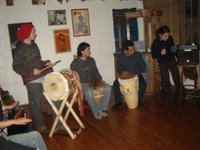 Sindicato Sonoro!
 Amigos! (That's Claudia, my oh-so-gracious host, in the red.)
 Sindicato Sonoro!

 Amigos! (That's Claudia, my oh-so-gracious host, in the red.)
Sunday, September 10, 2006
This one's for the boys in Abercrombie
 SLAYER played a concert in Santiago Friday night and I missed it! Damn!
I was talking to a guy that went to the show, or rather went and stood outside the fence, because, as he put it, with a band like Slayer (or rather, Eslayer) it sounds pretty much the same wherever you're watching them from. He said it was crazy - there was this big group of teenage Chilean metalheads all standing outside the fence, all into it, but then it started to get crazy and the cops came and started beating people up.
I was trying to think of how to ask "Where did they park all the four-wheelers?" and " Was everyone huffing glue?" in Spanish, but I couldn't find it in the dictionary.
Saturday, September 09, 2006
Cumpleaños feliz!
When it's your birthday, you can wait around for your friends to throw you a party, or you can simply throw one for yourself. Claudia's in the business of producing things - concerts, publicity campaigns, tours - and so when she wants to put on a party, it's all thought out. DJ duties split between her friend Luís (DJ Gros!: He comes with his own soundsystem) and her boyfriend Sebastian. A short set by Sindicato Sonoro, Sebastian's group that specializes in Colombian folk music. Ample space for dancing, lounging, drinking, smoking, both inside and out on the patio. The cost of snacks and hors d'oeuvres split between everyone. Rum, pisco and Chilean red wine flowing like, well, wine.
Parties work on a different time frame here than they do in Montreal. The very earliest guests arrive around 11pm, with a fashionably late entrance being around 1:30am or 2. We didn't get to bed until 6am - the sun was just starting to come up.
I just worked the room - as the only extranjera in a room full of Chilenos I had tons of obvious fodder for conversation. I talked to a ton of people. It's really interesting to see everyone's different take on your foreign-ness and where they want to take the discussion of it. As a North American, some people let their contempt for all things USA ( a.k.a Gringolandia) out on you. Some people try very diplomatically to show that they know there's a difference between Canada and the US. And some don't care about where you're from; they're more interested in your impressions and experiences in their country.
But like any good party, it wasn't all talk. Sindicato Sonoro , though missing a few of their musicians, were great. Tons of percussion, and a singer. They're doing a show this Thursday with the full band and complete with dancers. I can't wait.
There were several people at the party that I had met the last time I was here, including Mario, the guy that looks like Rick Mercer, and this guy Felipe, that apologized profusely for being so wasted when I'd met him in '05, and assured me that the only reason he declared his love for me and told me he wanted to accompany me on the plane back to Canada was because he was so drunk. ¡Que son frescos los chilenos!
I also got to put what I learned in the salsa and merengue classes I took this winter to work. Not quite the same experience as dancing in class, when you take into account that your partner's probably drunk, self-taught, and that the DJ may throw a cumbia or a cueca into the mix. And then there was this weird guy that kept asking me to dance. Picture Adam Sandler's Boy Scout character all grown up and wearing a poncho. Let's just say that my glass had to be refilled or I suddenly had to go to the bathroom halfway through the songs that he wanted to dance to.
We finished the cleanup a few hours ago, interspersing bouts of picking up cigarette butts from underneath the orange tree in the garden and mopping the floor with hearty helpings of Chinese food.
¡Feliz Cumpleaños!
Thursday, September 07, 2006
Being touristy
Claudia had to work today, so I thought I´d venture downtown on the metro and do a bit of the tourist circuit.
I wandered around a bit on Alhumada and Huérfanos, two pedestrian streets that are sort of like a chaotic open air shopping mall. Buskers and street performers abound; there was a elevator-music version of Pink Floyd's Another Brick in the Wall blasting from loud speakers all the way down the street as well.

I eventually got to the Plaza de Armas, a wide-open square flanked by various historical buildings and a huge church. In the square itself are more buskers, people selling arts and crafts, people hanging out, benches, trees, statues, and bums and dogs. Amongst the usual offerings of handicrafts and jewellery in the craft stands were several booths selling somekind of cream derived from snails that was supposed to cure skin problems: psoriasis, acne, infections, etc. I'm not quite sure what part of the snail is used in the making of this cream - I didn't get close enough to ask.
 It was sort of cloudy and ovecast so I went to the Pre-Colombian Art Museum (tres cool) and ate lunch on a terrasse on Huérfanos before going for a walk on the Cerro Santa Lucia. It's this little oasis of gardens, paths and green space right smack dab in the middle of downtown.
It's interesting wandering around the streets here this time of year. As opposed to my summertime visit in 2004, right now everyone, including me, is semi-bundled up in long pants, sweaters and jackets. I feel like it hides my gringo-ness a bit more and I thus blend in and can walk around town without drawing the kind of negative "I'm foreign, rob me!" attention I'm usually nervous of attracting. So as comfortable as I was last time wandering around this city, I'm even more so this time around.
(By the way, I didn't take these pictures. They're randomly taken of the web - God bless Google Image Search. Mad props to the original photographers, whoever you are. )
Wednesday, September 06, 2006
Frenching old men
I keep almost kissing old men. And women and children, for that matter. Here, when you greet someone, you do the kiss on the cheek thing, but as opposed to the kiss on either cheek the Quebecois do, here they just do one cheek. But going in for the second bec is a hard habit to break. Several times I've almost smashed my face into the person I'm greeting. I'll have to work on that one.
Another Chilean custom I'd forgotten about is their eating schedule. Breakfast is pretty normal, but then they eat their main meal of the day at lunchtime, which happens anytime between 2pm and 5pm. Supper ranges from non-existent to a light snack late in the evening. Throw an evening get-together with a couple of friends and a bottle of wine into that mix, though and you end up with a drunk and hungry Norteamericana whose stomach in wondering why it's midnight and she hasn't had supper.
And it's cold here! Well, it's not actually cold by Canadian standards; it's springtime, so evenings and mornings can go down to maybe 7 or 10C and then when the sun comes out it'll go up to maybe 20C. But the thing is, houses here aren't insulated, there's no heating, and the windows don't close tight. So inside is more or less the same temperature as outside. So everyone's walking around in wool sweaters and fleece and shoes or slippers. And half the time when visitors come over they keep their jackets on (their winter parkas!). The good thing is is that the beds are piled high with huge feather duvets and blankets. I guess the only way to warm up is to have another glass of wine...
Safe and sound!
So I'm here! My flight got in right on time this morning. I think this must have been the smoothest plane trip I've ever taken: no flight delays, no lost baggage; they didn't swab my baggage for explosives; and the flight from Miami to Santiago was EMPTY, so everyone could spread out and lay down over several seats.
And by some sort of great coincidence, on the flight from Montreal to Miami I was sitting with a woman and her father, both from Buenos Aires. They had been vacationing in Montreal. She gave me some tips on Argentina and also her business card - she has a business where she rents rooms out to foreigners and travellers. So the options are piling up on where to stay in Buenos Aires.
I knew I had arrived in Chile not just from the breathtaking landing over the Andean Cordillera, but from the behaviour of the immigration agent. He must have been about 19 years old, and, bien fresco, as they'd say in Spanish: this little Don Juan who was just oh so happy to have to stamp the passport of a young gringa tourist. He's like "How long are you staying in Chile?" and I was like, "One month," and he's like "Why such a short visit? Stay for longer!" And it went from there...
Claudia and her cousin Susi picked me up at the airport and we made our way through Santiago's morning rush hour toward Claudia's place. She lives at this amazing house with seriously 15 foot ceilings, an awesome little garden/interior patio, a wood stove and swinging western doors! The ceilings are so high that all the bedrooms and the living room have like a little loft built in. I get to sleep on a fold out couch in Claudia's humumgous bedroom (except for when her boyfriend's over... then I get to sleep on the loft in the living room!! :)
After sleeping all day, we started celebrations for Claudia's birthday, which is today. First her boyfriend cooked us this kick-ass lasagna, then her family came over. I had met most of them the last time I was here. I was out in the garden playing soccer with her nephew Sebastian when everyone starts to freak out because they'd just discovered someone had broken one of the windows on her cousin Carola's truck and stolen a backpack and a jacket. So all the men immediately jumped into the truck and sped off, yelling, in an effort to try to find the thief and do, well, I'm not so sure what: Chastize him? I just went back to playing soccer.
Then a couple of Claudia's close friends came over and we busted into the wine. I should have some pictures soon. The REAL birthday bash is happening this Friday.
Time for bed - it's been a long day.
(For anyone reading this, dont forget you can leave comments! Tell me how you're doing....!!)
Monday, September 04, 2006
Leaving...
So, job's done. I've crammed the contents of my life into a backpack. I've crammed the contents of my two-bedroom apartment into a 6 by 9 foot storage locker. I've replaced the vital contents of my lost wallet (btw, if anyone runs into any identity thieves pretending to be me, uh, make a citizen's arrest or someting). I've had farewell brunches and bottles of wine.
Now I've just got to make it through security and get on that plane. They're forecasting thunderstorms in Miami tonight....
Now I've just got to make it through security and get on that plane. They're forecasting thunderstorms in Miami tonight....
Subscribe to:
Posts (Atom)

